Skip to content

Cuba part II

The tour dispersed on Christmas day.  There are a few of us staying on in Havana for a couple of days and we decide to meet for dinner.

Don and I have moved to a Casa Particulares, which is about 10 minutes out of Old Havana. I’d describe it as the best house in the worst street.

Amidst crumbling buildings and unkept gardens, we arrive in front of a manicured lawn and a renovated 3 storey house.

We receive a warm welcome in a mix of Spanish, English and sign language.  Our large air-conditioned room comes with a mini bar, already stocked.

Our host, Lucca, and his wife are having Christmas dinner on the rooftop terrace. I think they are disappointed that we are heading out, but only after we finish the beer and BBQ skewers that are thrust into out hands.

From Old Havana to our Casa the taxi had been $10, but returning back for dinner it was only $6, that’s because Lucca hailed it. From then on we negotiate a lot harder.

We meet for Christmas dinner.  Steve and Rachel met us at La Bodeguita Del Medio for Pre-dinner drinks.

The bar claims to be the birthplace of the Mojito which it has been making since 1942; it was also one of Hemingway’s regular haunts.

Yuri had recommended a Paladar for Christmas dinner, even taking us and introducing us to the owner, earlier that day. We’ve been told dinner was $20 which includes a drink.

They did manage to up-sell most of us to the lobster, prawns and fish option for $25.

However, when we got the bill a heated discussion erupted.  We had been charged much more than was expected, a large irreconcilable amount under the umbrella of ‘taxes’.

Eventually we agreed on a price, but we left feeling the locals were trying to take advantage of the tourists.

Day 2:
Boxing day is a lazy sleep in – we didn’t even venture out until the afternoon.

It was too hot to do much and we headed back to our Intrepid hotel and made use of the pool.  Later we met up with Kate, strolled around Old Havana, and had a light dinner overlooking the square.

Day 3:
Our casa is about 5km from Old Havana and we decided it would be a good walk.

On our way, we spot a barber and Don took the opportunity to get a haircut.  The local currency price is the equivalent of $1, but he charged Don $5 (and then probably took the rest of the day off).  Still a bargain for us and he did a great job.

We acquired a friend along our walk, a friendly and informative local who seemed happy to tag-along with us and chat.  Of course, he really wanted money and in the end we gave him $2 just to leave.

Lucca, our host runs an Italian restaurant; he is in fact Italian, married to a Cuban.  We decide to check-out his restaurant which is a few Kms away.

It’s a Friday night and we struggle to hail a taxi.  Eventually we end up in a collectivo (shared) taxi, there are already 2 passengers upfront with the driver and the one in the back sits on a wooden box to make room for us.

We paid $5, which also probably covered everyone in the car.

After a superb dinner, Lucca hails a random car to drop us home for $4.  This is not unusual, drivers will pick up people along the road to make money and especially love to make tourist dollars.

This slideshow requires JavaScript.

Day 4:
We are heading out to Vinales for a few days.  It was cheaper to organise a car with a driver than to rent one, plus it was an opportunity to travel around in a classic 1950’s car.

Raul picks us up in a 1953 purple Plymonth with black leather upholstery. I’m not sure it’s the original colour, but it’s been well looked after..

Vinales is about a 2 hour drive, one the way we stop at the Reserva de la Biosfera Sierra del Rosario and lunch with pink flamingos.

Arriving late afternoon we are greeted warmly by Sonia and her neighbours, our Casa Particulare is part of a little community of houses.  We make the assumption, that it’s a family all living together.

From the well kept streetscape of freshly painted houses, manicured lawns and gardens, Vinales is doing well. Always a rich farming district, tourist dollars are also now pouring in.

Rocking chairs are ubiquitous across Cuba. You’ll find at least one on every front porch in Vinales. In the evening, Cuban’s sit and chat to their neighbours.

Our host provides dinner and we pre-ordered Lobster (for something different). There was so much food; chicken soup to start (1 less chicken running around the yard), salad, brown rice and beans, white rice, plantanes and yakka (like a sweet potato) and 1 large lobster each.  All for $8.

Day 5:
Breakfast is again an endless feast, which makes us feel guilty because we simply don’t eat that much. From now on, we know to ask for just coffee and fruit.

Raul drives us to Playa Cayo Jutias, where we spend the day relaxing on a beautiful beach.

Sonia (our host) made reservations that morning for dinner at La Palmetas, the Paladar is renowned for slow cooked pork. Once again dinner is an abundance of food, including a whole pig!  There was no way we even eat even half of it, though it was pretty skinny pig.

Driving back the owners asked if they could get a ride, we thought it was just one of them, but 7 of us pile into the Plymouth!

Day 6:
What better way to see the tobacco plantations than on horseback. Though, what we thought was going to be a 2 hour ride turned into 5!

Our tour meanders through the rich agricultural Valley of Vinales.

We visit a tobacco farm where they explained the process for making cigars, take a blissful swim in the limestone caves and our final stop is a farm for refreshments on the way home.

It was a lovely way to explore the valley – I just don’t need to get on a horse again for a while!

It’s Lobster again for dinner, Don is having chicken (that’s now two less chickens running around).

Chickens in Cuba take free range literally.  They are all over the place.  Walk down the street and you will pass a chicken scratching in the dirt somewhere.  Sit in a bar and you’ll have chicken’s running around your feet.

Order chicken and ….(need I say more).

Having Raul and a car has been nice, but now we are in Vinales, we realise we really don’t need him.

Tomorrow we are going out to the island of Cayo Levisa by bus and ferry. The local bus service is apparently quite good so, we will also catch one back to Havana.

It was a restless sleep tonight, somewhere nearby there is music being pumped out in large decibels.  The heavy disco beat vibrates through the bed.

We seem to encounter a lot of noise through Cuba. Just when the music dies down the roosters wake-up. I’d recommend to anyone intending to visit – bring ear plugs!

Day 7:
Cayo Levisa is a Small island with one hotel on it – we looked into staying a few days but it was booked out.

It’s your typical beautiful tropical island and we had a lovely day, but Playa Juintas was just as nice, if not more so.

The day trip includes a buffet lunch, which was pretty ordinary.  Fish soup followed by baked fish.  The fish was OK, I skipped the rest.

The sides included Pumpkin, first time I’d seen Pumpkin. There was rice and the usual salad of tomato, cucumber and shredded cabbage (I’ve not seen lettuce, it’s always cabbage).

Dessert was guava puree and stewed oranges (that looked like they had been stewing for days).

On the way, the bus had stopped at a house near the ferry port and dropped of a container. On the way home the driver collects his container, now full of fresh Milk.

After a disappointing lunch we have dinner at one of the Trip Advisor recommendations.  It turned out to be the best meal we’ve had in Cuba.  Possibly because it broke the monotony of chicken, pork or fish; even lobster was becoming repetitive.  Instead, we had Lasagna and Duck.

It’s New Year’s eve and we had great intentions of staying up, but fell asleep by 10pm – expecting it to be noisy throughout the night, it was surprisingly quiet.

Day 8:
The bus to Havana leaves at 7:30am.  Sonia is up and kindly makes us coffee, fresh mango juice and some bananas.

In Mexico I had purchased some bee pollen, after being convinced of its vitamin qualities. It looks like yellowish/brown grit, you sprinkle about teaspoon on fruit or cereal each morning.

This morning I tip a generous teaspoon on the plate to dip my banana in.  After a while I notice the pollen seems to be moving on it’s own.  On close inspection I can see little bugs crawling out of it.

Needless to say, that was the end of the pollen.  I’m just hoping those little bugs aren’t making a home in my stomach!

The two hour bus trip takes nearly five, only because people seem to be getting off at random stops along the way, usually in the middle of nowhere.

Walking around Vinales we’d seen a lot of scarecrows in front of people’s homes. We learn that it’s a new years tradition to make effigies that represent all the bad things that have happened during the year.  Burning them will allow the new year to start afresh.

As we leave Vinales, we see the remnants of the burnt effigies.

Just outside of Havana we pull-off to the side of the freeway, an old man on an ancient tractor is waiting.

Out the window I watch something being exchanged.  The elderly man also brings out a thermos of coffee and shares this with the driver. They chat for about 10 minutes before we continue on our journey.

On our horse ride we had met Louisa and Marco, a Portuguese couple (now living in Canada). We kept running into them during our stay in Vinales and they are also on the Bus.

With four nights to fill in, we decided to find a spot by a beach. Louise and Marco had told us about Playa del Estes and the town of Guanabo. They are also heading there, so we share a taxi from the bus depot in Havana.

We decide to try and find a Casa on or near the beach and start walking around.

One dude wants to take us a few blocks back and show us a Casa.  We’ve been warned that people in the street will want to show you a Casa and want a commission. This is exactly what this guy wants.

We enquire at a house just a block back from the beach, our friend is following and tries to claim he is bringing us here.  We make it clear that he is not. Our new landlord, Gabriel shows us the room, well actually it’s more like an apartment with a terrace.  For CUC$25 we take it.

Gabriel was an engineer, now retired. Evidently very handy and always making things. He shows us how the shower works, which I guess he’s rigged-up himself. “Turn the water on first, then flick the fuse, so you don’t get scalded”, he explains. I hope I don’t get electrocuted!

Whilst the water only trickles out of a small pipe coming out of the wall, it’s hot enough to do the job.

Day 9:
The local bus into Havana costs CUC$1 each. Though we later learn that it’s CUP$1. No wonder everyone was happy on the bus, at the value of a CUC to CUP, our $2 paid for the entire bus!

We utilise the Hop-on-off tourist bus to head back out to the Occidental Hotel, (where we stayed with Intrepid). Once again, to make use of their pool and wi-fi for the afternoon.

The bus tour isn’t that exciting, the commentary is limited, which you can hardly hear through the muffled speakers.

The return journey is no more exciting, we actually take the same route back and have no commentary.  Guess that’s what you get for $5.

Day 10:
Beach time for a few hours and then we find the local ‘fast’ food joint; it took nearly an hour to order and get your food – though freshly cooked. All the prices are in National, but they happily accept CUC$.

It’s back into Havana to meet-up with Steve, from our cycling trip.  His Mum Mary, joined him in Cuba and they have been out at Varadero.

Varadero is the Cancun of Cuba, built for the European tourist.  Many of whom fly in, spend a week in an all-inclusive resort (which they never leave) and claim they’ve been to Cuba. Steve confirms this is true.

Outside of a day tour, they didn’t leave the resort, though they seemed to have picked a good one.

Catching-up with people you know is a rarity for us. We enjoy a lovely dinner, sitting outside in Old Havana.

Day 11:
Our last day in Cuba. We spend it lazying on the beach just up the road at Playas del Este.  We run into Louisa and Marco again and they join us.

It becomes clear that we’d arrived just before rush hour, the beach quickly fills with people and it’s a party atmosphere with a Cuban band playing and people dancing all day long.

We can highly recommend staying with Gabriel and Mary. Staying in their Casa Particulare was a true Cuban experience. They are lovely people and we learn’t a lot about Cuba from them.

Gabriel explained that when Casas were first allowed, you had to pay a fee of CUC$350 per room per month. Hence, no one could afford to run a Casa.

The government then changed it to $30 per room, per month. Casa’s charge around $35-$30 per room per night, which means they can now make a reasonable living.

Gabriel speaks about his three children living in the US and 1 in Spain.  Another is doing military service in Cuba and studying Computer Science.

The three children in the US received visas via their mother.  Apparently, she went to a meeting outside Cuba and never returned.  It took 6 years to arrange for the children to be allowed to leave Cuba and live in the USA.  You have to wonder, what life was like to make the decision to leave your children and seek asylum in another country.

Day 12:
After a total of 14 lobsters between us, it’s Hasta la vista Cuba!

It’s been a fascinating place to visit, we will watch with great interest to see how things change as the relationship with the USA develops.

Even as I write this (two months later – OK I’m a little behind).  American’s are already lining up to visit, travel restrictions are relaxing, direct flights are scheduled and the first ferry from Florida is in the works.

Stay: Gabriel and Mary: Calee 470 No.303 e/ 3ra. Y 5ta, Guanabo, La Habana Cuba Tel:537 7963186 Email:gabriel.guanabo@gmail.com

This slideshow requires JavaScript.

Intrepid Travels Through Cuba

Cuba is a country that has always been shrouded in mystique.

A somewhat forbidden destination, even more so if you are an American.

It conjures romantic images of rhythmic latin music and salsa dancing, the sweet smell of cigars, drinking Mojitos with Hemingway and driving 1950’s cars.

It’s a country frozen in time, slowly unthawing as it’s forced to liberalise economic and political structures to survive.

To even attempt to understand Cuba, you need to delve into it’s history. So here it goes…

The arrival of Christopher Columbus in 1492 is probably the place to start.

From this point on, the Spanish raped and pillaged the island of natural resources and decimated the native population through disease and enslavement.

Colonial Cuba provided the Spanish with timber for ships, tobacco and sugar.

Between 1756 and 1763 the ‘Seven Years War’ was fought. Simply, the French, Spanish and British were fighting over who owned what. It involved many parts of the world, including North and Central America.

As a result of the war, Britain did a deal with the Spanish; the Brits got Florida and Spain kept Cuba. Perhaps one of the most decisive points in history for Cuba.

Over time the Cubans grew resentful of the Spanish and the first War of Independence began in 1868, lasting ten years.

Whilst defeated and exiled, the revolutionaries continued to build resistance against the Spanish.

Three key rebels; Maceo, Marti and Gomez returned to Cuba in 1895, to launch the second War of Independence.

With the rebels keeping the Spanish busy, the USA took the opportunity to attack Havana resulting in the Spanish-American War.

The Spanish lost and relinquished sovereignty over Cuba to the United States in 1898. At this time, the US Navy established it’s base in Guantanamo Bay.

America returned sovereignty to the Cuban Government in 1901 and for 60 years Cuba was ruled by an unpopular military dictatorship.

In the early 1950’s the resistance movement once again gained momentum, now under the leadership of Fidel Castro and Ernesto ‘Che’ Guevera.

In 1959 Castro gained control and began to convert Cuba into a communistic system.

Castro re-ordered Cuban society, instituting land reform, building health and eduction systems and imprisoning his opponents.

Relations with the United States rapidly deteriorated; at the same time Soviet ties grew stronger.

The US imposed an embargo on Cuba in 1960 and broke diplomatic relations in 1961 (after the Bay of Pigs invasion).

Tensions peaked during the Cold War in the Cuban Missile Crisis. Cuba’s alliance with the Soviets provided protection against military attack from the US.

The Cuban economy relied strongly on Soviet support, resulting in devastating hardship with the collapse of the Soviet Union in 1989

A ‘special period’ was declared. Ration books were introduced as the country teetered on the brink of famine.

The loss of cheap petroleum from Russia was significant. Gas became unobtainable for most and contributed to the economic meltdown.

Industry, mechanised farming and food distribution all but ceased.

Many Cuban’s lost up to 25% of their body weight. They survived on drinking sugared water and eating anything they could get their hands on; you don’t see many cats in Cuba!

Cuba turned to Tourism in the 1990’s as a means to provide a much needed source of economic stimulus.

In 2006 Castro transferred power to his brother, Raul, who has continued gradual reforms, creating a somewhat capitalist-Socialist hybrid.

Before I end the history lesson, something I found interesting:

During the ‘Special Period’, research** shows that Cuba experienced an abrupt downward trend in illness, including the onset of type 2 diabetes. The research suggests this was a result of diet and exercise.

Without the availability of petrol and petroleum based chemicals, farmers returned to manual and organic farming methods. Cubans virtually became vegans overnight, as meat and dairy products vanished.

Out of adversity does come some good. Perhaps the western world with rising rates of obesity, diabetes and heart disease could learn a lesson, or two.

Day 1: Arrive Havana
Clearing immigration in Cuba takes nearly as long as the flight did.

There are 18 lanes open, each 50 people deep.  It’s a haphazard queuing system and you just stand behind someone and hope for the best.

Our first impressions yield a lack of efficiency (or technology); the process is slow and very laborious.

Finding our luggage is the next challenge; there is one long conveyor belt loaded with luggage from three planes.  To make room, bags are randomly scattered around the belt, which is where we found ours, hidden amongst a dozen other pieces.

Our first glimpse of how things are changing in Cuba is the long line through customs. Cubans returning are overloaded with baggage; they are carrying flat-screen televisions, ceiling fans and bundles and bundles of things.

Either there is no baggage limit, or they just paid a fortune in excess fees.

We managed to bypass the Customs queue and make a quick exit into more mayhem.

There is a sea of people waiting for passengers.  Lucky for us, the Exodus staff (operating our Intrepid tour) are at the front.  We are introduced to Yuri, our tour guide.

There are four of us being collected at the same time; Steve, is already on the coach and Kate turns up not long after us. They have both flown in from London.

We are surprised to find ourselves at a fairly modern looking hotel.  We had set our expectations low, so this was a pleasant surprise.

All the hotels in Cuba are government owned.  Many have been built in the early ’90’s, when Cuba opened itself up to tourism.

Yuri asks us to be in the lobby to depart at 8:18am, he likes to be precise – In case his name didn’t give it away, Yuri has a bit of Russian in him!

Day 2: Cienfeugos

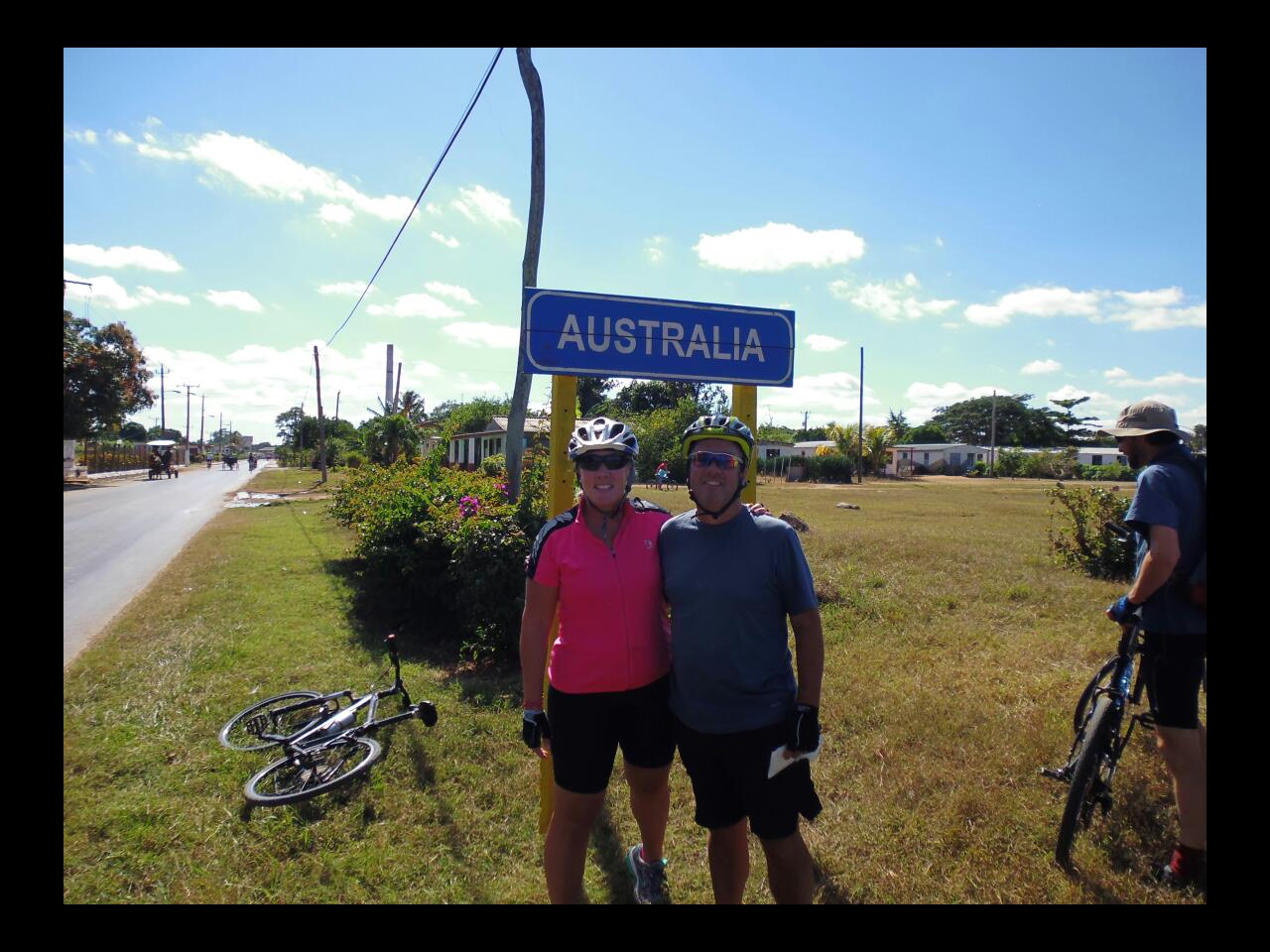
The Cycling begins in Australia!

The Cycling begins in Australia!

We feel like seasoned Intrepid travelers now, but we are still full of anticipation to meet our fellow travelers.

Having met Steve and Kate the night before, we introduce ourselves to the remaining 13 as we board our coach in the morning.

The majority are from the UK: Nicola is from Edinburgh, Carla and James are from Bristol, Sarah and Andy from Manchester, Tracey and Sharon, Oxford (though Sharon is Australian).

There are also two Norwegians: Kirsti and Sidsel.  Then the Antipoedians, including; Rachel from New Zealand, Marcel and Anna from Sydney and Lachie is from Brisbane.

We are missing Shelley (a Canadian living in the UK), who joins us a day later.

The coach heads east out of Havana. We will get to explore the city when we return from our cycling expedition.

Our first day of cycling starts from the township called Australia, who would have thought!

We ride to the coast and stop for Lunch. Yuri has provided cheese and ham croissants, bananas and a brownie. It hits the spot, though is not a typical Cuban meal.

Today’s ride is 40km. Having not been on bikes for months, along with hot and humid weather, it takes its toll on Don and I. We both eventually give in and take advantage of the support vehicle.

Jose, our bus driver, always remains close behind, ready to rescue a tired rider.

The riders finish at a beach and we cool off in the warm Caribbean waters, perfect to relax aching and tired muscles.

The water is so clear you can see the fish swimming up to you.  Some even like having a nibble!

Back on the bus, we stop off at the museum that commemorates the Bay of Pigs invasion, a significant event in Cuba’s recent history.

We arrive at Cienfeugos around 7pm, in time to shower and change for dinner.

Everything you read about Cuba says “don’t expect anything from the food.” But, so far we have been pleasantly surprised.

Breakfast each morning has been a standard buffet affair of fresh fruits, cereals (limited to maybe the equivalent of chocolate, or plain rice bubbles) and omelets made to order. Even the coffee has been OK.

Tonight we eat at the Palacio de Valle. The beautiful building is reminiscent of Spanish-Moorish art. The restaurant specialises in seafood.

Maybe its because we just spent two months in Mexico, we’re glad to see there isn’t any derivative of a tortilla in sight.

Since seafood is the house specialty, I couldn’t go past the lobster. The first of many I have in Cuba.

Day 3: Cienfuegos to Guajimico
The colonial centre of Cienfuegos has a European flavour, wide Parisian-style boulevards and elegant colonnades, the perfect back drop to the vintage cars parked in front.

Unfortunately, we only had a short time to explore the town before we are back on our bikes. Today it’s a 45km ride.

We set off cycling outside of Cienfuegos and into the countryside, enjoying the stunning views of the Escambray Mountains across valleys of sugar cane.

The road undulates close to the coastline and through gentle hills until it reaches Guajimico.

Guajimico is a small agricultural community situated halfway between Cienfuegos and Trinidad.

We stop for lunch at a Paladar, a private restaurant (as opposed to a government one).

Since 2011, when Raul relaxed the restaurant regulations, Paladares began popping up everywhere.

Motivated to earn ‘tourist’ dollars, which in Cuba’s case means convertible pesos.

Cuba is the only country in the world to print two currencies. The local Cuban currency is CUP (coop) and in 1994 the convertible peso – CUC (kook) was introduced for tourists.

The CUP trades at 24:1 CUC. The CUC is pegged to the US dollar at 1:1.

An average Cuban earns the equivalent of $30CUC a month (just to be clear, that = US$30 a month).

The opportunities to earn CUC are on the increase and many Cuban’s are taking advantage of this.

The potential influx of American tourists and their generous tipping philosophy is just one reason Cuban’s are excited about the improving relations.

So, back to lunch: it consists of beef (I think, though beef is not very common), with rice and beans.  Not what I’d choose for lunch but after 30+km of riding, we need a few carbs.

Desert is a guava syrup dripped over a soft cheese, apparently a Cuban delicacy – it didn’t taste bad at all.

We are back on our bikes for under an hour before we arrive at the seaside resort; Villa Islazul. The afternoon is free to relax, swim and enjoy the views whilst sipping a Mojito or two.

Dinner is a choice from the three Cuban staples: fish, chicken or pork. If you ask “How is it cooked”, don’t expect “grilled, baked” or even a description of some exotic sauce, the answer will simply be “good.”

Day 4 & 5: Trinidad
The ride today is along a road that clings to the shimmering Caribbean coastline all the way to Trinidad. Well, that’s the description in the tourist brochure.

What it fails to tell you is that thick dense shrubbery blocks your view of the shimmering coast and that you’ll be fighting a strong headwind all the way.

So the not so easy 20km, was also somewhat less scenic than we hoped. Though it does takes us across a few bridges providing views of picture-perfect bays.

We ride through small communities and stop on the side of the road at a stall selling fresh fruit and revive our energy with fresh coconut juice, mango, guanabana’s and other exotic fruits.

After we’ve reached Trinidad, Yuri takes us to Palacio Brunet a stunning colonial mansion dating back to the 1740’s. The building now houses the Museo Romantico.

It is packed with 18th century antiques and gives a fascinating glimpse into the lives of wealthy slave-owners during the town’s mid-colonial 18th century period.

After lunch, Yuri takes those who are interested to visit a cigar shop. Don and I decide to explore a bit on our own.

We have two nights in Trinidad in a homestay, or Casa Particulares. Since 1997, the Cuban government has allowed Cubans to rent out rooms to tourists, providing Cuban families with new sources of income and access to sought-after CUC’s.

We meet our host Josephina who warmly welcomes us into her home and shows us to a large and bright bedroom, with it’s own bathroom.

Trinidad is well preserved (and has earned a UNESCO badge); it’s like stepping back into Spanish colonial times.

The town rose to prominence during the sugar boom (early 1800’s) and the wealth generated by the industry remains visible in the town’s once grand mansions, colourful public buildings, wrought iron grill-work and cobble-stoned streets.

Trinidad is alive with music, even if it’s simply for the benefit of the tourist. Walk around a corner and a band spontaneously begins to play (or did they recognise a tourist on the way).

Many cuban’s cannot afford cars, so bicycles and horses are a regular form of transport. We meet one elderly entrepreneur who provides his donkey for photo’s. You can’t ride him, but you can have a photo with him.

Trinidad is the first town where we get a real insight into Cuban life. Walking along the cobbled streets, there are shops selling random things like beer, buckets, a freshly butchered pig.

People sell food from their homes; a horse drawn cart, or a barrow being pushed around the street sells fruit and veggies. There are no supermarkets as we know them. You may find a small store with a limited range of products lining a few shelves.

Cubans still receive rations for rice, cooking oil, eggs, chicken and pork. Children under the age of 7 receive additional milk and beef rations.

The following day is free and most of us choose to head to Playa Ancon and enjoy the beach. The keener cyclists amongst us ride the 15km.

No, that does not include Don or I, we share two vintage taxis: a well preserved 1950’s Chevy and Dodge.

Dinner that night is another seafood extravaganza; once again I dine on lobster. We are entertained with live cuban music (which wouldn’t be complete without the old classic ‘Guantanamera’).

After dinner, we head out in search of more Cuban music. We stop in the square where people are salsa dancing, then end up at Casa de la Trova which has a reputation for attracting the best Trovadors (traditional singer/songwriters).

Day 6: Topes de Collantes National Park/Lake Hanabanilla
We leave Trinidad on the coach and wind up over the stunning Topes de Collantes National Park and coffee plantations.

Cuba was once rich in coffee production, producing 60,000 tonnes annually, it’s production now is around 6,000 tonnes.

One reason is the lack of interest in farming. Why would you want to be a farmer in Cuba; working long laborious days, 7 days a week, earning the same $30CUC as someone else working in a comfortable office?

We stop for coffee in the National Park and a few of the more serious cyclists sign waivers and head off to add a few more up-hill kilometres to the daily ride.

The majority of us are more sensible and start the ride in the valley. The scenery is lush with small farms and villages giving way to open vistas as we descend towards Manicaragua.

Lunch is sandwiches and then we start the final climb towards Hanabanilla, situated on the shores of Lake Hanabanilla and surrounded by lush tropical hills.

This is one of the most beautiful days in terms of scenery, it just happens to be a long, gruelling uphill slog.

There were many moments where I was tempted to throw it in and wave down the bus, I can hear it chugging slowly along behind us, but with the encouragement of my cycling companions, who appealed to my competitive nature, I pushed through, (by-the-way, Don retired long before).

Exhausted and elated as I wobbled off the bike in front of our hotel, a barman greets me with a well earned Cuba Libra.  Now, that’s the way to finish a bike ride.

A nearby Paladar served lovely fresh trout.  The food is again ample and comes to US$13 a head. It was one of the best meals of the trip.

Day 7: Santa Clara to Havana
In the morning we take the bus to Santa Clara. This was the first major city to be liberated by Castro’s army in December 1958.

Today a number of monuments commemorate this important period of Cuba’s history, including the mausoleum of the legendary Che Guevara, where we stop for a visit.

Guevara remains both a revered and reviled historical figure, polarized in the collective imagination in a multitude of biographies, memoirs, essays, documentaries, songs, and films.

As a result of his perceived martyrdom, poetic invocations for class struggle, and desire to create the consciousness of a “new man” driven by moral, rather than material incentives, he has evolved into a quintessential icon of various leftist-inspired movements.***

I love that Cuban museums hoard everything from baby photo’s, school reports and even a tube of the guy’s toothpaste!

If you are interested in knowing more about Che, read his book; ‘The Motorcycle Diaries: Notes on Latin American Journey’

At this point we say goodbye to Sarah and Andy, who are heading off to spend a few days in the sun.

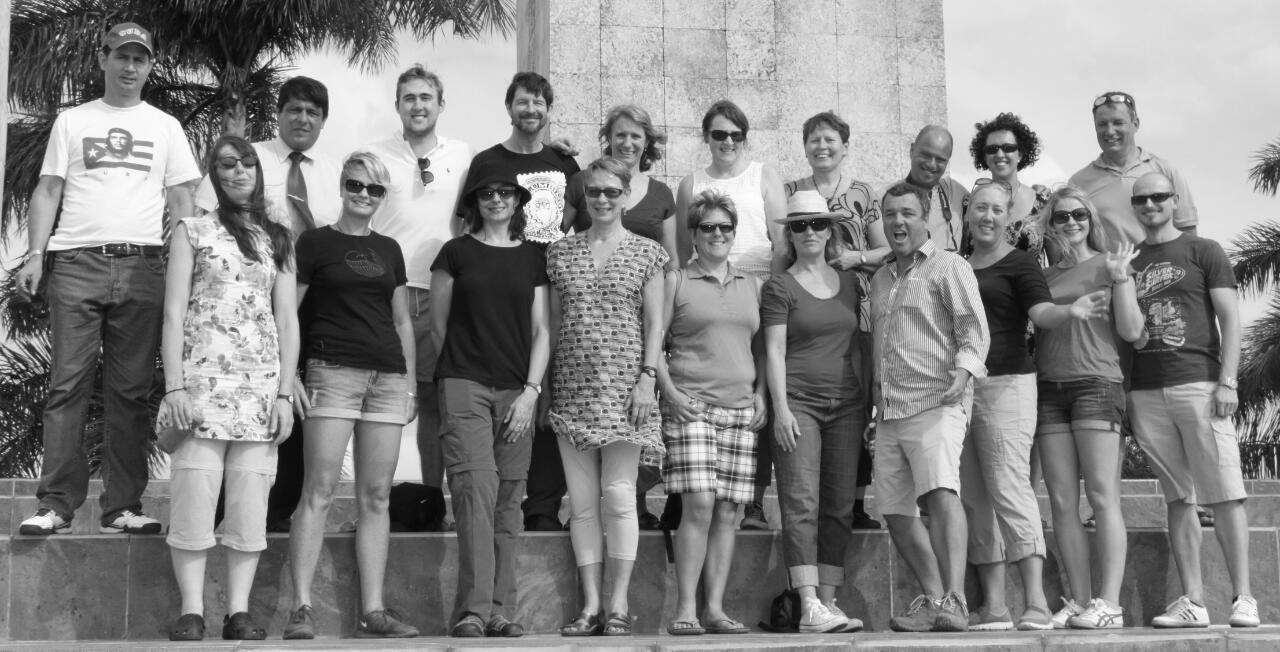
The cycling gang

The cycling gang

Day 8: Havana
Our final day with our Intrepid companions is spent walking through Havana with Yuri as our guide.

We are back in Havana, claimed to be one of the finest colonial cities in the Americas with narrow streets, spacious plazas and glorious Spanish architecture.

However, there is an air of faded grandeur about the place with paint peeling off buildings and ’50s and ’60s American automobiles still dominating the roads.

There are significant restoration works underway and like Bordeaux (France), you can see that Havana will soon be returned to it’s former glory.

It’s Christmas day, though, there are very few signs of this; there are no christmas trees or decorations and no festivites going on.

Religion was banned under Castro’s regime; churches were shut down, or occupied by the government.

Religious groups survived in secrecy until the Pope’s visit in 1998.  Castro relaxed his attitude and even made Christmas day a public holiday. Religious celebrations still remain conservative.

Old cars dominate the street scape. US car imports came to a halt in 1959 when America placed embargos and Castro stopped Cubans purchasing cars on credit.

Few cars were imported after this, except for a few from Europe and Russia, which provided Laudas and heavy vehicles.

In Havana, you do begin to feel like you have a target on your back.  Everyone is trying to make a dollar out of you.

It’s almost impossible to take a photo without someone expecting a tip.  There are women brightly dressed in traditional Cuban costumes, plus a street parade that really isn’t a street parade, but rather more performers wanting a tip.

You do get a bit cynical by the end.

With Obama’s efforts to improve relations with Cuba the doors are open and the future opportunities for Cuba are looking promising.

The biggest question will be whether it can survive its struggle to hold onto its socialist ideology?

This slideshow requires JavaScript.

References

* City of Cienfuegas web site

** http://www.theatlantic.com/health/archive/2013/04/how-cubans-health-improved-when-their-economy-collapsed/275080/

***Copied text from http://en.m.wikipedia.org/wiki/Che_Guevara

Interesting read: http://www.foreignaffairs.com/articles/139458/julia-e-sweig-and-michael-j-bustamante/cuba-after-communism

Mayan Riviera, Mexico

This is one very short post (compared to the last one).

After our Intrepid trip dropped us at Playa del Carmen, we ventured an hour down the road to Tulum.

We have 12 days before we fly from Cancun to Cuba; we’ve heard good things about Tulum, so we going to check it out.

One of our Intrepid companions – Catherine, is also heading down to Tulum for a few days and we give her a lift.

Catherine is a bit more organised and has her accommodation booked.  We drop her at Ahau, a lovely resort right on the beach.

Unfortunately they didn’t have any spare rooms. They did recommend Yogo Shala directly across the road – it had a few basic rooms with shared bathroom.  Not bad, but we thought we’d see what else we could get.

Don and I stroll up and down the beach checking out various accommodation options.  They range from US$350 to about US$80 per night.

We, of course, would prefer to spend at the lower end of the price spectrum.

One thing that really annoys me is the insistence to quote in US$.  Well, we don’t have US dollars, just Mexican Pesos – the local currency!

We find a spot a bit further down the beach from Ahau called Coco’s.  The rooms look nice and it’s within our price range – US$87 per night.

We decide this is the place to stay, as we check in the receptionist says she needs to convert the US$ to Pesos and the exchange rate they use is 14.75.  Well, at the time the current rate is about 13.5.

My response was “you’re taking the piss.” That’s 10% more for a lousy exchange.

Now, I’m all for making the most of a situation, but quoting in US$ and then ripping you off with an exchange rate well above the market rate is extortion.

We cancelled the booking and we went back to Yoga Shala.  They at least offered the standard rate of 13.3.

In the end, it turned out to be a good choice.  Whilst not beachfront, it was directly opposite Ahau who had no issues with us making use of their sun lounges and umbrellas.

Our room on the second floor is very simple; the windows are screened but no glass, there is a mosquito net around the bed and a fan if it’s hot.

We share two bathrooms between 5 other rooms.  I rarely see anyone, so it was never a problem and the place was very clean.  The showers are hot but partly salt water, makes for interesting hair washing.

The kitchen is very basic, no fridge, just a cooler with a block of ice in it.  No means to boil water, so this resulted in the purchase of a one-cup coffee machine.

Yes, that’s right – we are already carrying a plunger around and we now have a drip filter coffee machine.

We did the maths:  to purchase a fairly ordinary coffee across the road was about 30 pesos and the coffee machine cost 100 pesos, so 4 coffee’s and we’re ahead!  Simple really.  Plus, I now get coffee in bed!

For the next 8 days we slipped into a comfortable routine.

Wake-up to a coffee, write some blog, cross the road and plonk ourselves on a sun lounge for the day with a book.

In the afternoon; retreat back to Shala for more blog writing, reading or maybe a nap, source some dinner (or not, depending on what (if) we had for lunch).

We had the pleasure of Catherine’s company for the first 4 days and aside from sharing a beach, the three of us would seek out a restaurant for dinner each night.

Tulum is somewhat ‘Byron-esque’, much more laid back than Playa.   Lots of ‘beautiful’ people doing yoga and meditation on the beach – generally in designer swimwear, or nude!

It’s a stunning spot, the beach is one of the most beautiful we’ve been to – we’ve now been to a lot of beaches.

We moved back up towards Cancun (and the airport) for our remaining four nights, staying in Puerto Morelos (PM).  We found a lovely B&B called Casa Caribe  Coincidently, run by an Australian, Catriona, and her assistant Lisa (American).

PM has a different vibe again; its a fishing port and starting point for diving and snorkeling expeditions.  The beach is not as spectacular, yet there is something charming and appealing about PM.

The locals, many of whom are expats like Katrina and Lisa, are very welcoming and create a laid back feel about the place.  I can see how many of them arrived and just never left.

There are some great restaurants in PM.  Our favourite find would be T@cos.com and their ‘Hawaiianos’ shrimp and pineapple taco.

We also indulged on a succulent steak at Al Chimi Churri ; no need to worry if you can’t eat it all, there is always a few dogs hanging around to finish the scraps.

We’ve seen lots of stray dogs around, but the ones in Puerto Morelos are the best fed we’ve seen, thanks to Chimi Churri’s I think.

We drive into Cancun for a day and quickly vow to never return.

It is one long strip of all-inclusive resorts, behind are designer shopping malls and restaurants that you’ll find all over the world.  The only thing that reminds you that you are in Mexico is the stamp in your passport!

Tomorrow we are off to Cuba.  We have a night back in PM on our return and the girls at Casa Caribe have let us leave some things with them.

This slideshow requires JavaScript.

Intrepid Travels through Mexico

Don and I have been travelling by our own design for 7 months.

We like the freedom of going where we want, changing our mind and doing things at our own pace.

We are the first to scoff at ‘groupies’ being herded around by a tour guide holding high an umbrella, coloured flag and the best we’ve seen; a big bright felt flower.

So, it is with some trepidation that we arrive to meet our Intrepid companions.

For the duration of this adventure we will be under the direction of Chimi, our tour leader.  We also have Carlos who is learing the ropes from Chimi.

Chimi is responsible for getting us from A to B; he knows where we are staying and what we are doing each day.

He will recommend where to eat, extra activities and where the most reliable ATM’s are (among other useful tidbits of information).

To our surprise we quickly adapted to being a passenger and both of us will admit we enjoyed it much more than we thought.

I made a comment to Don: “Have you noticed, we don’t argue when we aren’t driving.”

Over the next 15 days we will get to know our 16 companions well, swapping tales of the days adventures over a meal and solving the problems of the world with a few Margaritas.

We will share many hours on buses, mini vans and taxis as we travel through central Mexico to the Caribbean coast

We are all eager to explore the colourful culture and life of Mexico, visit ancient Aztec and Myan civilisations, bargain for a souvenir in the local markets, swim in Cenotes, sip local Mezcal and dine on fabulous local cuisine.

Day 1 & 2: Mexico City
After the meet and greet formalities are out of the way, we head out to Dinner, where we start to get to know people.

It’s a diverse multi-national group which includes: French, German, English, American and Australians, along with our two tour guides: Chimi (who seem’s to have lived all over the world) and Carlos (Mexican).

Day 1: we opt-in for the the day trip to the Ancient Pyramids of Teotihuacan, located 50km from Mexico City.

The City of the Gods was a huge urban centre with a population of 200 000, occupied from 100 BC.

At its peak it was one of the largest cities in the world, and its influence was felt all over Mesoamerica. The city was completely abandoned around 750 AD; no one really knows why.

The Temple of the Moon sits at the Northern end of the Avenue of the Dead. The layout of the city has an eerie symmetry, another mystery yet to be explained. The largest Pyramid and third largest in the world is the Pyramid of the Sun.

It’s position to the Temple of the Moon is significant; a sight-line directly over the top of the Pyramid of the Sun marks the meridian, thus allowing the priests of the city to fix the times of noon and midnight with complete accuracy.

It is an impressive sight and our guide is extremely knowledgable and passionate about Teotihuacan. In the end, perhaps a bit too much passion; my enthusiasm for standing in the hot sun whilst he rabbits on (and seems to somewhat repeat himself) does wear thin.

We should have followed Neil and Margie’s plan – pay a taxi to drive you out, drop you at one end, walk through to the other end and get picked up – 3 hours rather than 6!

However, it was well worth the experience and set the expectations on what was to come.

Day 3 & 4: Puebla
Our first day on the road and it’s a fairly easy one, the group had opted to upgrade from a local bus to 2 x private mini vans for the 2 hour drive to Puebla.

This allowed us to stop on the way, at the town of Cholula. Here the Spanish built a beautiful church on old Mayan ruins.

The town of Cholula has 365 churches, one for each day of the year. We still have 364 to go!

In the park below the church we watch the Danza de los Voladores – four flyers represent wind, fire, earth and water.  They launch themselves off a 30 meter pole slowly spinning to the ground.  The ritual is recognised by UNESCO as an intangible cultural heritage.

Puebla was founded as “La Puebla de los Ángeles” or “La Angelópolis” on April 16, 1531. It was the first city in central Mexico founded by the Spanish conquistadors that was not built upon the ruins of a conquered Amerindian settlement.

Four decades after Mexico’s independence, General Ignacio Zaragoza’s army defeated French expeditionary forces near Puebla on May 5, 1862, in the Battle of Puebla. It was after this battle that the name of the city was changed to Heróica Puebla de Zaragoza.

In the late 19th and early 20th centuries a considerable number of European immigrants came to the city, mainly from Germany, Italy and Spain.

Nowadays, the “Colonia Humboldt” neighbourhood shows the influence of the Germans in the city’s architecture, and in the town of Chipilo, now absorbed by the metropolitan area of the city.

The city has some wonderful colonial architecture and the tree lined Zócalo (town square/centre), with its free WiFi, is a hub of activity both day and night. We have the added bonus of Christmas lights and in the evening the Zócalo resembles a luminescent fairyland.

A highlight was undoubtably the Lucha Libre – Mexican Wrestling. Sporting colourful masks and lycra outfits the wrestling trios take to the ring.

They catapult off the sidebars to launch themselves across the ring, into their opponent and sometimes into the crowd. None of it can be taken too seriously.

This slideshow requires JavaScript.

Day 5 & 6 : Oaxaca
Our first public bus is surprisingly comfortable, similar to a modern greyhound.

The 5 hour journey from Puebla to Oaxaca is uneventful. Well, almost; we leave our small camera on the bus – lost forever.

This is not as disastrous as it could have been – the camera was dying a slow death and I had downloaded the photo’s the night before.

Oaxaca, the historic home of the Zapotec and Mixtec people, contains more speakers of indigenous languages than any other Mexican state. The city centre is (of course), another UNESCO World Heritage Site.

Chimi is a good salesman, we opt in for another day trip.

Our first stop is Santa Maria, it’s claim to fame is a 2,000 year old Tule tree with the world’s widest trunk.  To aid in preserving the tree, the town moved the main road.

It’s an impressive tree. With some imagination you can see the gnarly twisted trunk looks like the face of a lion and trunk of an elephant…

Next is Mitla, an archeological site that was occupied from as early as 900 BC.  Though the remaining buildings date between 200 – 900 AD.

The village had great importance as a place of burial and the Zapotec are believed to have practised human sacrifice here.

Unique to Mitla is the intricate geometric stonework, it is unlike anywhere else in Mexico. Each design is handmade, each piece of stone cut by hand to fit and then set in mortar.

We stop for lunch and a dip – for those who are up for it, at the natural springs and fossilized falls of Hierve el Agua.

On the way home, we call in at a traditional weaving factory and learn how the natural dyes are produced and wool hand weaved into rugs.

Our last stop of the day is a Mezcal tasting.  Mezcal is made from the Maguey plant (same family as tequila). The straight spirit is not my thing, but they also produce a variety of liquor flavours which aren’t too bad.

Oaxaca is considered the culinary capital of Mexico. Renowned for its Moles; a rich sauce that take hours to prepare, Chapulines; fried grasshoppers, along with chocolate, lots of chocolate!

We dine on tlayudas; a mexican pizza made with a large crispy tortilla piled with a variety of toppings and melted Queso Oaxaca, (stringy cheese – a speciality of the region).

Walking into the Zócalo for the evening, we come across a street closed to traffic and full of couples ballroom dancing.  Apparently a regular thing.

On the evening of departure, Don and I are chilling at the hotel, waiting to catch the overnight bus to San Cristobal.

Chimi suddenly exclaims that he’s got the bus time wrong and we are leaving in 50 minutes! Most in the group have scattered for dinner.

Those of us who are ready, head off to the bus station (a short 10 min walk). On the way, the alluring smell of a street stall cooking mini burgers mexican style was too enticing, we manage a quick snack before the bus.  And they were really good burgers!

The remaining members of the group continue to arrive, the last with minutes to spare.  Close call Chimi!

This slideshow requires JavaScript.

Day 7 to 9: Overnight bus to San Cristobal
It’s early morning when we stumble off the bus in San Cristobal, after a 10 hour overnight journey.  I had managed to sleep most of the way, but am looking forward to a good coffee.

The hotel has one room available and we pile all the luggage in and head out for breakfast. San Cristóbal is located in the Highlands of Chiapas, at an elevation of approximately 2,100m above sea level.

The city was named after Bartolomé de Las Casas, a Spanish priest who defended the rights of the Native Americans and was the first bishop of Chiapas. It is the third-largest community in Chiapas.

San Cristóbal was one of the four cities that the Zapatista Army of National Liberation took in its uprising in January 1994.

Many people in San Cristóbal, who consider themselves traditionally rooted here (called “Coletos”) are against the Zapatistas. However, there are also parts of the population that sympathize or openly cooperate with the Zapatista movement.

Chimi has organised a tour to the nearby towns of Chamula and Zinacantan.  They are two examples of indigenous communities maintaining many of their ancient Mayan traditions and living by their own laws.

Chamula is home to the Tzotzil’s, one of the largest indigenous groups in Chipas. They are fiercely independent; practicing polygamy (multiple wives), electing their own leaders and enforcing their own laws.  The Mexican government rarely intervenes.

We are warned not to photograph any individuals or take photo’s inside the church.

Religion is founded in ancient Mayan rituals, blended with the more recent influences of Catholicism; for example they don’t sacrifice people anymore, just chickens!

Other than a Catholic priest visiting once a year to baptize people, the church is looked after by Shamans.

Inside, there are no pews and the floor is covered with pine needles. Wooden boxes containing Saints line the sides of the church. Individuals in the community are chosen to look after a particular saint.

Worshipers in Chamula bring incense, candles and offerings of coke, fanta and beer, the different colours represent different spirits.

Can you guess who the wealthiest person in Chamula is?  The Coca Cola distributor!

In contrast the town of Zinacantan is more traditionally Catholic and does not practice any form of sacrifice or polygamy. The church has pews and coke sales are a lot lower.

We also visit a family’s home where the women weave textiles and the mother offers us fresh tortillas.  Women are well respected in their culture and play a pivotal role in the community.

After our excursion, Don and I have a lazy day next.  We explore the town of San Cristobal on foot.  The best finds are a fresh juice bar; Mum and Son are operating through their kitchen window, blending any fruit concoction you want.

Down the road from our hotel is a Wine and Tapas Bar where we have a late lunch snack.  That night we attend a live theatre show called Pakal.

Pakal depicts the history of the ancient city of Palenque, when the Tonina Skull Snake dynasty attacks the city and the son of Pakal is taken prisoner.

The battle between the two kingdoms culminates in the ancient game of Pitz (a ball game). The story (which I probably don’t have right) concludes with the death of Pakal and his rebirth.

The play is a good introduction for our day in the historic ruins of Palenque and the myths surrounding the tomb of Pakal.

This slideshow requires JavaScript.

Day 10 & 11: Palenque
The evening before departing San Cristobal for Palenque, we learn that demonstrators are blockading the road (apparently a frequent occurrence).

To avoid getting caught up in the commotion, we needed to leave at 5 am (rather than 8 am), so we can get through the trouble spot before they start stopping the traffic.

The road blocks are generally people from the local communities raising money – through a somewhat forced donation!

The journey is nondescript and we break the 6 hour road trip by visiting the Cascadas de Agua Azul

We arrive at the town of Palenque early afternoon.  Chimi warned us that this is not a town to wonder at night, being a major traffic route for the cartels.

No fear of that, we do a reconnaissance and there isn’t anything redeeming about the place.

The ancient ruins of Palenque are nestled in the lower foothills of the Sierra Madre of Chiapas, fringing the coastal plain of the Gulf of Mexico, amidst a high tropical forest abounding in surface water.

It began as a farming hamlet, perhaps sometime around 100 BC, that is, during the so-called Formative Period [2500 BC – 300 AD].

Over the Early Classic Period [300 – 600 AD] the village grew, and in the Late Classic [600 – 900 AD] became the city which ruled much of what is now the states of Chiapas and Tabasco.

At that time, Palenque’s development peaked, as evidence in the complexity of its architecture, ceramics, and particularly its inscriptions.

The interpretation of Palenque’s inscriptions and other archaeological information has provided us with the names of its rulers and other leading figures.

The Town of Palenque is about 7.5 km. away from the Archaeological site. The only reason to stay in the town of Palenque is to visit the archaeological site.

The ancient Maya city of Palenque dates back to 226 BC. Looking back on all the ruins we visited in Mexico, I found Palenque to be the most impressive.

It remains hidden by the jungle that swallowed it for over 1,200 years.

There are hundreds of buildings spread over 15 sq km, the current excavations expose only 10% of the civilisation that flourished here for nearly 1,000 years.

Whilst the city is smaller than Chichen Itza it has been well preserved and contains some of the finest architecture, sculpture and carvings of the Mayan era.

This slideshow requires JavaScript.

Day 12 & 13 : Merida

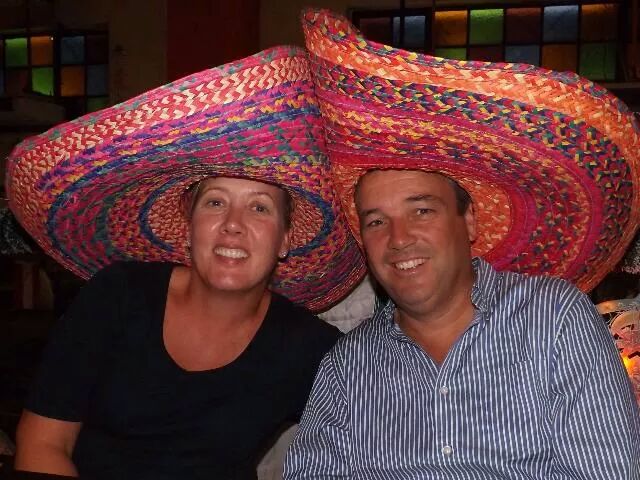
Merida - dinner out

Merida – dinner out

The Spaniard Francisco de Montejo founded Merida on January 6, 1542. When the Spaniards arrived, Merida was a large Mayan city known as T’ho, situated on what is now the Main Plaza.

It was conquered by the Spaniards, who dismantled all the pyramids and used the huge stones as the foundation for the Cathedral of San Idelfonso (1556-1599), the oldest Cathedral on the American continent.

The Cathedral, situated on the east side of the Plaza, is only one of Merida’s many interesting sites. Directly across the Plaza is the Palacio Municipal (1735), Merida’s Town Hall. On the South side is the Casa de Montejo (1542), the former home of the Conqueror of Yucatan.

The Palacio de Gobierno (1892), on the North side, houses 27 murals by Fernanco Castro Pacheco, illustrating the somewhat violent history of Yucatan.

One of the major influences on Yucatan history is the henequen plant, also called sisal (for the Yucatecan city of Sisal from which shipments left the Continent). This plant became known as ‘green gold’ or ‘oro verde’ for the wealth it lavished upon the hacienda owners in this area.

In the early 20th Century, as a result of the henequen or sisal trade, Merida was the home for numerous millionaires who built their lavish homes on Paseo Montejo, and their impressive haciendas throughout the jungle surrounding Merida.

Whilst others opted to participate in additional activities and day trips, Don and I declined any of the extra day trips.  We spent our days soaking up the local ambienance by wandering the streets and relaxing by the hotel pool.

As you can see, we didn’t even take any photo’s!

Day 14 & 15: Chichen Itza & Playa del Carmen

Chichen Itza is probably the most famous ancient site in Mexico.  It is undoubtedly the best restored and due to it’s yucatan location receives over 1.2 million visitors a year. Many are sun seeking day trippers from Cancun and other resorts along the Mayan Riviera.

Our group pays a visit on the way from Merida to the coast.  Chimi has organised a guide for us – after our Teotihuacan experience, the group opts for the ‘short version’.

You can’t help but be impressed, though Chichen Itza is more crowded and much more tourist orientated than the other ruins we have visited. Our guide also turns out to be excellent. He sets a good pace, is knowledgeable and entertaining throughout the tour.

Of course this is a UNESCO world heritage site and to save me writing pages, if you wish to read more click here.

After spending a few hours at Chichen Itza and you need a few hours, we stop for lunch and a swim in a natural cenote.

A cenote is a sink-hole, I say natural because Chimi informs us that many cenotes around the coast are not natural and have been created with the help of dynamite to enhance a tourist spot.

The water is clear and crisp, it’s a welcome relief after a morning in the humid jungle.

Our final destination is Playa del Carmen, located on the beautiful Mexican Caribbean Coast some 40 miles (60 kms) south of Cancun.

The Mayan used it as launching point for pilgrimages to Cozumel, which they held to be the home of Ixchel, the Goddess of the Moon, Love, Pregnancy and Childbirth. Though remnants of buildings left behind by this ancient civilization still dot Playa del Carmen’s shores.

Playa, as it is now affectionately known, was originally named Xaman-Ha “Waters of the North”. It’s a living vibrant part of the Maya World (Mundo Maya).  A perfect base from which to explore the Cancun-Tulum Corridor of Quintana Roo (called the Mayan Riviera).

The guide books will tell you about miles of unspoiled white sandy beaches and crystal-clear Caribbean waters, a popular place for visitors looking for sun, sea and cheap margaritas.

What they fail to tell you is that you are back in ‘resort-land’.  This part of Mexico caters for over 2 million of it’s northern neighbours and Europeans escaping winter.

We have one last group dinner and the following day people start to depart.  A few of us are spending an extra day or two in Playa, relaxing on the beach, enjoying massages for US$20.

It is certainly the ideal spot to end a tour.

This slideshow requires JavaScript.

In Summary

wpid-img_9831862041304.jpeg

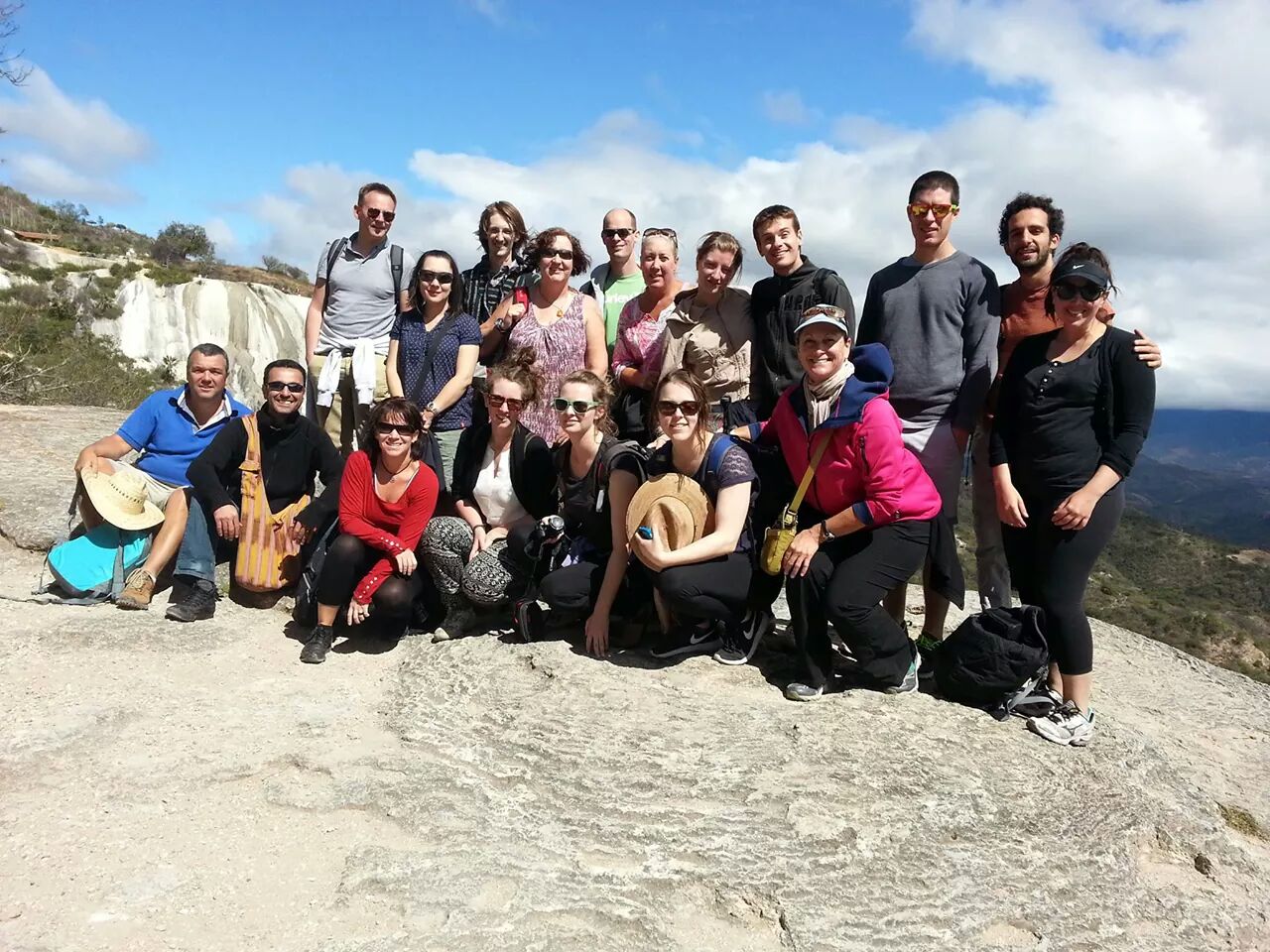
The Intrepid Travelers

We enjoyed travelling with a group much more than we thought we would.  No doubt we were lucky to have had such a great bunch of people, with whom we shared many laughs througout our trip.

There is something innate in human nature, that allows a group of random individuals from different nationalities and backgrounds to travel together.

How quickly we can all adopt cultural and personal difference to create a cohesive group – at least for 15 days!

We will no doubt keep in touch with many of them, be it simply through facebook (what did we do before fb?), or better still, to catch-up again, somewhere in the world.

To our fellow intrepid travelers, I purposely did not introduce any individual through this blog. Simply because you all know the rule: “what goes on tour, stays on tour”.

Special Acknowledgements:

Intrepid Tours, Mexico Unplugged: we would recommend the trip without hesitation.  We’ve been impressed with Intrepid and already booked another trip with them.

Chimi – a great tour leader, who provided his insider experience and travel expertise to make it a memorable and enjoyable trip.  We also enjoyed debating and solving the problems of the world with him.

And Carlos; genuinely interested in everyone, he will no doubt make another great tour leader.

Many descriptions and information quoted are taken from Chimi’s tour notes. Thanks Chimi, hope you don’t mind.

A few photo’s are also courtesy of our Intrepid travellers, I have taken the liberty to download from fb.

Mexico City

Neil, Margie, Don and I fly to Mexico City. The airport seems to have an unusually high police presence, many in riot gear. Our driver informs us that they are expecting trouble.

It’s November 20 – Revolution Day, the perfect day for a protest. The Mexican people have a few things to protest about, at the top of the list is the fate of 43 students, missing since September.

The students are now believed to have been executed. Their abduction resulted in the arrest of the City Mayor and his wife. Protests have broken out across the country.

We are warned not to venture into the Centro Historico that night. The news reports show that most of the activity culminated at the Plaza de la Constitución.

We ventured a look the following day, there was no sign of any disturbance. It was like: OK, you’ve had your fun, now go home and we’ll clean-up.

Mexico City confronts all your senses: it’s crowded, chaotic and polluted. It reminds me of Asia, the hustle and bustle on the streets and the erratic crazy driving.

Apparently you don’t need to sit a driving test or take any lessons. Just pay the US$45 license fee and it’s straight on to the road, learn as you go!  Not suprising, the road toll in Mexico is outrageous.

Word of advice: belt-up and hold on when you get in a taxi!

The city sits at an altitude of 2,240m, high enough to induce the effects of altitude sickness. Something I have never suffered from until now!

It also sits in a valley, with a intoxicating haze hanging over it. It rates in the top 10 most polluted cities in the world.

All this aside, it is also an enticing city, we found it surprisingly charming. It’s many layers require more than 2/3 days to unwrap.

We however, have only three days to explore the city with Neil and Margie. Then they head home and we join the first organised tour of our trip.

Aside from wandering through the Centro Historico and ticking off the regular tourist spots, the highlight in our exploration has to be Mexican Food Tours.

The tour explores Polanco, a trendy cosmopolitan neighborhood. Our host, Connie was fantastic; passionate and knowledgable about food, Mexican history and culture.

We had such a great time with Connie, we invited her for a drink afterwards. She took us to Jules Basement a ‘speakeasy’ bar. The bouncer secrets us through a coolroom door positioned at the back of a taco restaurant.

We decend down into a strikingly modern bar. Large white skulls encased in glass serve as tables and the walls are covered with black leather panels. It serves a range of exotic and traditional cocktails.

Connie provided us with further recommendations on places to eat in the city. We followed her recommendations for breakfast and dinner the following night. Enjoying both.

Well, it’s time to bid farewell to Neil and Margie who are the last of Don’s birthday crew to leave the party. It’s been a long party!

Don and I spend our last day on the Hop-on-off bus.  We’ve now done a few of these around the world and always find it a good way to get an overview of the city.

We leave the bus at Coyoacan, one of the 16 boroughs.  It’s a charming part of the city, with cobblestone streets, colonial mansions and colourful villas.

The local markets overflow with fresh produce with colourful piñatas hanging from the roof.  Tantalizing smells linger in the air from the food vendors cooking up fresh  mexican fare.

Also in the area is the former home, now museum, of artist and  international icon; Frida Kahlo.  Her self portraits feature on bags, t-shirts and other tourist memorabilia you find throughout Mexico.

Frida has been described as “one of history’s grand divas…a tequila-slamming, dirty joke-telling smoker.  She was renowned for her lavish indigenous dress and festive dinner parties, she hosted for the likes of Leon Trotsky and Nelson Rockefeller.

This slideshow requires JavaScript.