30 April, La Paz
Today we join our Intrepid tour from La Paz to Lima. The tour is actually run by Dragoman, who specialise in overland travel through South America.
The trip begins with a group meeting at 6pm in our hotel. Our fearless tour leader is Rich, with driving support from Tige and Jez, who is on his maiden voyage as a trainee.
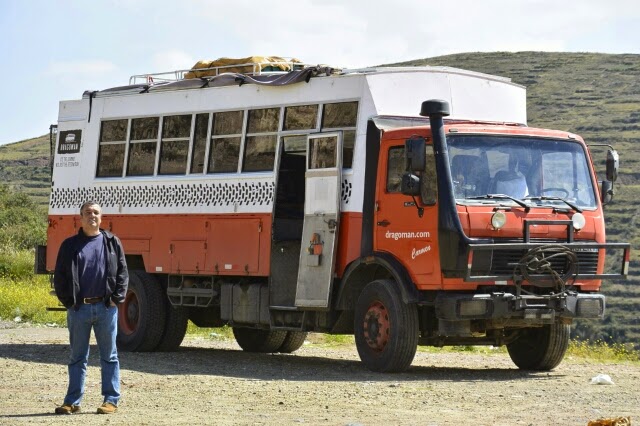
Our transport for 21 days will be ‘Carmen’. Tige points out that it’s a truck, not a bus, and we are not to insult Carmen by calling her the later.
We are joining Carmen on a small part of her 96 day journey, a voyage which began in Rio in February and will end in June at Cartegena.
Some of the passengers have been onboard since the beginning or for much of the trip: Michelle, Aynslie, Lisa, Manju, Birgit and Mary.
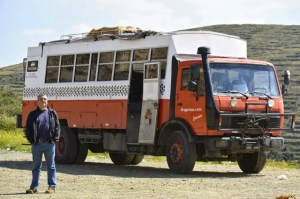
Carmen & Don
Then there is Donna, Courtney and Michael, who have previously done a leg on Carmen before jumping off and are rejoining again in La Paz.
Lewis was leaving the trip in La Paz, then decided to extend his holiday, which resulted in having to quit his job to stay on to Lima.
That leaves 9 newbies eagerly ready to jump on in La Paz; Greta and Agusta, Julia, Sarah, Bob, Matt, Kyle and the two of us.
Once introductions are made, paper work completed and instructions given for our morning departure, those who are up for it head out to dinner.
1 May, Copacabana
It’s an early 7:00am departure, in the hope of escaping the traffic chaos of La Paz – which is only somewhat of a success. We have 200km to cover to reach Copacabana.
It happens to be the Fiesta de la Cruz and there are celebrations Countrywide. We hit a procession on the outskirts of La Paz which makes navigating the potholes, crazy traffic and a crowd of people walking down the middle of the road, slow going.
Copacabana is a picturesque town on the shores of Lake Titicaca with an impressive Moorish-style cathedral. On Sundays the town fills with the faithful believers who walk up Cerro Calvario (the hill guarding the town) to make their dreams come true.
At the top of the hill numerous stalls sell all manner of miniature material goods from cars and buses through to houses and graduation certificates. The selected items are taken to a small altar where they are blessed, decorated with flowers and petals, incense is burnt and finally beer is sprayed over the whole ensemble.
A fascinating insight into local beliefs, as is the blessing of the vehicles in front of the cathedral. Thanks to the trip notes for that little insight.
Copacabana takes its celebrations seriously and this is a big weekend, not only is it the Fiesta de la Cruz, it’s also the Fiesta de la Chakana (Southern Cross) and the town turns the two festivals into a non-stop party for four days.
We arrive early afternoon as things are getting started. With streets blocked off we have to abandon the truck and walk into the town square.
Endless dance troops are parading by; each with their own band and elaborate colourful costumes, including fabulous masks and head-dresses.
The atmosphere is fun and lively, people young and old celebrating throught the town and who later invite us to join in.
Pacena (a Bolivian beer) are clearly supporting the event, handing out free beer to the parade participants – this keeps the party spirit going and by the end of the night, there are a lot of intoxicated Bolivians around town.
The celebrations go through to the early hours of morning, including a party outside our room until about 3am.
This slideshow requires JavaScript.
2 May, Copacabana
A little weary from the lack of sleep, we board a boat out to the historic Isla del Sol on Lake Titicaca for a 14km hike.
Inca mythology claims the island is believed to be the the birthplace of the sun and where the bearded white god Viracocha and the first Incas made their mystical appearances.
Even today Aymara and Quechua people in Bolivia and Peru still accept the legend of the sun being born on this island as their creation story.
There are a host of ancient ruins dotted across the island, along with tiny traditional villages and walking trails. There are no cars, Llamas and donkeys provide the transportation.
This slideshow requires JavaScript.
3 May: Lake Titicaca/Puno
Another 200 km drive takes us across the Peruvian border to the lakeside town of Puno.
Puno is a melting pot of Aymara and Quechuan Indian culture and traditional Andean customs are still strongly represented here. The town is known as the folklore capital of Peru and is famous for its many festivals and traditional dances.
Don and I find lunch at the local market close to where we are staying. Amongst freshly butchered meat (with roaming dogs hopeful for scraps) are stalls cooking up lunch, serving you at communal laminated tables.
We must have been looking hungry since a women at one of the food stalls ushers us with a friendly smile to sit down. We order the pollo lunch special at a costly AUS$5 for two.
It includes a huge bowl of soup, which itself would have been enough, followed by grilled chicken, rice and potatoes and a cup of sweet mint-like ‘mate’ tea, which I’ve now discovered is considered carcinogenic!
In the afternoon the Carmen gang participate in a friendly tuk-tuk race from the hotel to the port. After having the lead the race, it was clear our man had peaked early; we came a respectable third.
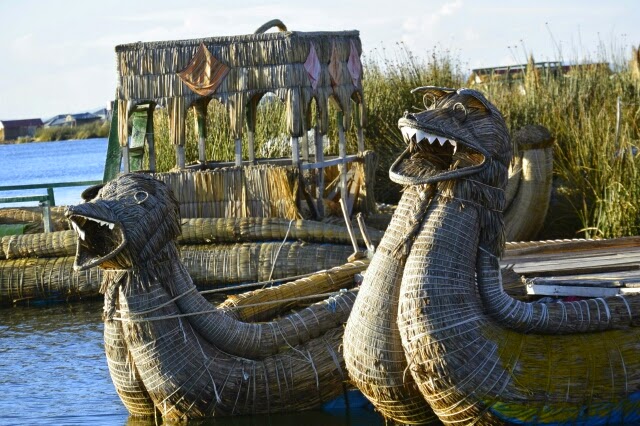
We board a boat to the floating reed islands of Uros on Lake Titicaca.
The Uros tribe warmly greet us and give a glimpse into what their lives on the reed islands are like, demonstrating how the islands are made and how they live. Then they delight in dressing us up in traditional clothes.
The Uros tribe pre-dates the Inca civilisation. According to legends they were superior beings, existing before the sun, when the earth was dark and cold. They were impervious to drowning and being struck by lightning until they fell from grace by disobeying a universal order and mixed with humans.
The tribe scattered, lost their identity, language and customs. Today the are known as the Uro-Aymaras, and now speak Aymara.
There are about 40 islands on Lake Titicaca made and re-made from the totira reeds which grow in the lake.
The reeds are essential to their existence, providing land and shelter, sustenance and transportation for the residential Uros tribe.
There existence is a precarious one; the reeds rot and constantly need replacing. Once dry they are susceptible to fire. Drowning is sadly a common occurrence, especially young children. The climate is harsh: cold, windy and at an altitude of over 3,800 meters, the sun can burn fiercely.
Yet they have endured centuries and outlasted the mighty Inca civilisation.
Alasitas are miniature that represent the desires and wishes of people and the Alasitas Market is on the night we are in Puno.
The crowded alleys are lined with stalls selling everything imaginable: husbands, wifes, houses, university diplomas and suitcases of money.
Our highlight was dinner – streets stalls roasting everything from guinea-pig to pork and lamb and we skip the guinea-pig, but devour a succulent meal of pork and lamb.
This slideshow requires JavaScript.
-15.925418
-69.335432



 automatically look for the bin to put the toilet paper in.



 Lucyandon's Adventures