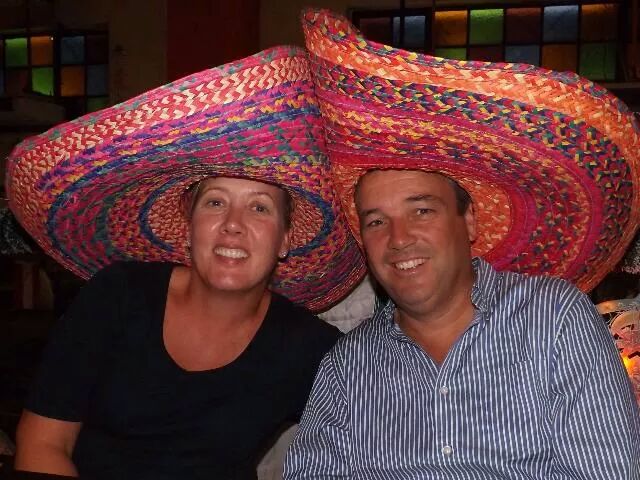
Don and I have been travelling by our own design for 7 months.
We like the freedom of going where we want, changing our mind and doing things at our own pace.
We are the first to scoff at ‘groupies’ being herded around by a tour guide holding high an umbrella, coloured flag and the best we’ve seen; a big bright felt flower.
So, it is with some trepidation that we arrive to meet our Intrepid companions.
For the duration of this adventure we will be under the direction of Chimi, our tour leader. We also have Carlos who is learing the ropes from Chimi.
Chimi is responsible for getting us from A to B; he knows where we are staying and what we are doing each day.
He will recommend where to eat, extra activities and where the most reliable ATM’s are (among other useful tidbits of information).
To our surprise we quickly adapted to being a passenger and both of us will admit we enjoyed it much more than we thought.
I made a comment to Don: “Have you noticed, we don’t argue when we aren’t driving.”
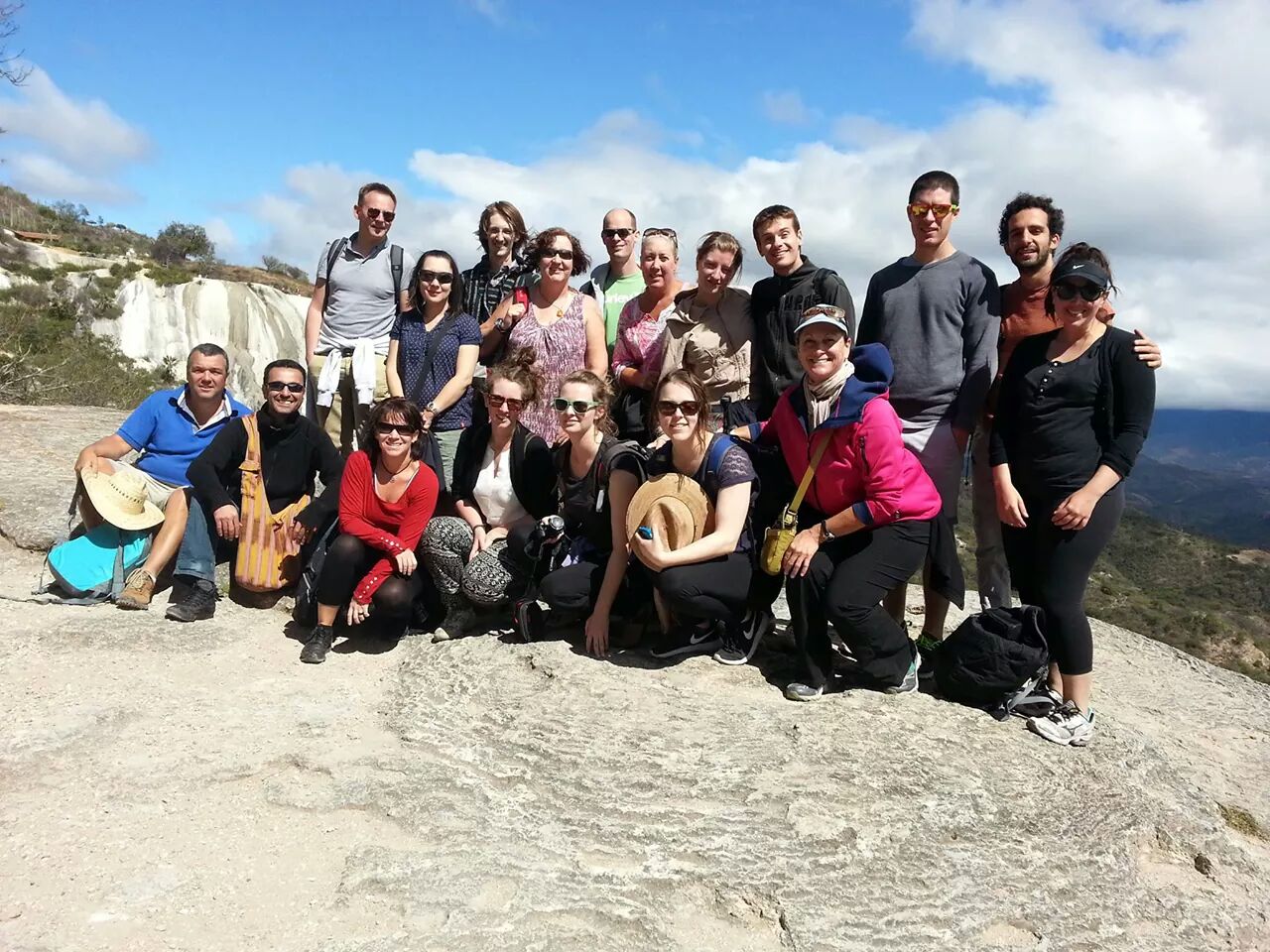
Over the next 15 days we will get to know our 16 companions well, swapping tales of the days adventures over a meal and solving the problems of the world with a few Margaritas.
We will share many hours on buses, mini vans and taxis as we travel through central Mexico to the Caribbean coast
We are all eager to explore the colourful culture and life of Mexico, visit ancient Aztec and Myan civilisations, bargain for a souvenir in the local markets, swim in Cenotes, sip local Mezcal and dine on fabulous local cuisine.
Day 1 & 2: Mexico City
After the meet and greet formalities are out of the way, we head out to Dinner, where we start to get to know people.
It’s a diverse multi-national group which includes: French, German, English, American and Australians, along with our two tour guides: Chimi (who seem’s to have lived all over the world) and Carlos (Mexican).
Day 1: we opt-in for the the day trip to the Ancient Pyramids of Teotihuacan, located 50km from Mexico City.
The City of the Gods was a huge urban centre with a population of 200 000, occupied from 100 BC.
At its peak it was one of the largest cities in the world, and its influence was felt all over Mesoamerica. The city was completely abandoned around 750 AD; no one really knows why.
The Temple of the Moon sits at the Northern end of the Avenue of the Dead. The layout of the city has an eerie symmetry, another mystery yet to be explained. The largest Pyramid and third largest in the world is the Pyramid of the Sun.
It’s position to the Temple of the Moon is significant; a sight-line directly over the top of the Pyramid of the Sun marks the meridian, thus allowing the priests of the city to fix the times of noon and midnight with complete accuracy.
It is an impressive sight and our guide is extremely knowledgable and passionate about Teotihuacan. In the end, perhaps a bit too much passion; my enthusiasm for standing in the hot sun whilst he rabbits on (and seems to somewhat repeat himself) does wear thin.
We should have followed Neil and Margie’s plan – pay a taxi to drive you out, drop you at one end, walk through to the other end and get picked up – 3 hours rather than 6!
However, it was well worth the experience and set the expectations on what was to come.

Teotihuacan – Avenue of the Dead

Climbing Temple of the Moon

Teotihuacan – Sun Pyramid
Day 3 & 4: Puebla
Our first day on the road and it’s a fairly easy one, the group had opted to upgrade from a local bus to 2 x private mini vans for the 2 hour drive to Puebla.
This allowed us to stop on the way, at the town of Cholula. Here the Spanish built a beautiful church on old Mayan ruins.
The town of Cholula has 365 churches, one for each day of the year. We still have 364 to go!
In the park below the church we watch the Danza de los Voladores – four flyers represent wind, fire, earth and water. They launch themselves off a 30 meter pole slowly spinning to the ground. The ritual is recognised by UNESCO as an intangible cultural heritage.
Puebla was founded as “La Puebla de los Ángeles” or “La Angelópolis” on April 16, 1531. It was the first city in central Mexico founded by the Spanish conquistadors that was not built upon the ruins of a conquered Amerindian settlement.
Four decades after Mexico’s independence, General Ignacio Zaragoza’s army defeated French expeditionary forces near Puebla on May 5, 1862, in the Battle of Puebla. It was after this battle that the name of the city was changed to Heróica Puebla de Zaragoza.
In the late 19th and early 20th centuries a considerable number of European immigrants came to the city, mainly from Germany, Italy and Spain.
Nowadays, the “Colonia Humboldt” neighbourhood shows the influence of the Germans in the city’s architecture, and in the town of Chipilo, now absorbed by the metropolitan area of the city.
The city has some wonderful colonial architecture and the tree lined Zócalo (town square/centre), with its free WiFi, is a hub of activity both day and night. We have the added bonus of Christmas lights and in the evening the Zócalo resembles a luminescent fairyland.
A highlight was undoubtably the Lucha Libre – Mexican Wrestling. Sporting colourful masks and lycra outfits the wrestling trios take to the ring.
They catapult off the sidebars to launch themselves across the ring, into their opponent and sometimes into the crowd. None of it can be taken too seriously.
This slideshow requires JavaScript.
Day 5 & 6 : Oaxaca
Our first public bus is surprisingly comfortable, similar to a modern greyhound.
The 5 hour journey from Puebla to Oaxaca is uneventful. Well, almost; we leave our small camera on the bus – lost forever.
This is not as disastrous as it could have been – the camera was dying a slow death and I had downloaded the photo’s the night before.
Oaxaca, the historic home of the Zapotec and Mixtec people, contains more speakers of indigenous languages than any other Mexican state. The city centre is (of course), another UNESCO World Heritage Site.
Chimi is a good salesman, we opt in for another day trip.
Our first stop is Santa Maria, it’s claim to fame is a 2,000 year old Tule tree with the world’s widest trunk. To aid in preserving the tree, the town moved the main road.
It’s an impressive tree. With some imagination you can see the gnarly twisted trunk looks like the face of a lion and trunk of an elephant…
Next is Mitla, an archeological site that was occupied from as early as 900 BC. Though the remaining buildings date between 200 – 900 AD.
The village had great importance as a place of burial and the Zapotec are believed to have practised human sacrifice here.
Unique to Mitla is the intricate geometric stonework, it is unlike anywhere else in Mexico. Each design is handmade, each piece of stone cut by hand to fit and then set in mortar.
We stop for lunch and a dip – for those who are up for it, at the natural springs and fossilized falls of Hierve el Agua.
On the way home, we call in at a traditional weaving factory and learn how the natural dyes are produced and wool hand weaved into rugs.
Our last stop of the day is a Mezcal tasting. Mezcal is made from the Maguey plant (same family as tequila). The straight spirit is not my thing, but they also produce a variety of liquor flavours which aren’t too bad.
Oaxaca is considered the culinary capital of Mexico. Renowned for its Moles; a rich sauce that take hours to prepare, Chapulines; fried grasshoppers, along with chocolate, lots of chocolate!
We dine on tlayudas; a mexican pizza made with a large crispy tortilla piled with a variety of toppings and melted Queso Oaxaca, (stringy cheese – a speciality of the region).
Walking into the Zócalo for the evening, we come across a street closed to traffic and full of couples ballroom dancing. Apparently a regular thing.
On the evening of departure, Don and I are chilling at the hotel, waiting to catch the overnight bus to San Cristobal.
Chimi suddenly exclaims that he’s got the bus time wrong and we are leaving in 50 minutes! Most in the group have scattered for dinner.
Those of us who are ready, head off to the bus station (a short 10 min walk). On the way, the alluring smell of a street stall cooking mini burgers mexican style was too enticing, we manage a quick snack before the bus. And they were really good burgers!
The remaining members of the group continue to arrive, the last with minutes to spare. Close call Chimi!
This slideshow requires JavaScript.
Day 7 to 9: Overnight bus to San Cristobal
It’s early morning when we stumble off the bus in San Cristobal, after a 10 hour overnight journey. I had managed to sleep most of the way, but am looking forward to a good coffee.
The hotel has one room available and we pile all the luggage in and head out for breakfast. San Cristóbal is located in the Highlands of Chiapas, at an elevation of approximately 2,100m above sea level.
The city was named after Bartolomé de Las Casas, a Spanish priest who defended the rights of the Native Americans and was the first bishop of Chiapas. It is the third-largest community in Chiapas.
San Cristóbal was one of the four cities that the Zapatista Army of National Liberation took in its uprising in January 1994.
Many people in San Cristóbal, who consider themselves traditionally rooted here (called “Coletos”) are against the Zapatistas. However, there are also parts of the population that sympathize or openly cooperate with the Zapatista movement.
Chimi has organised a tour to the nearby towns of Chamula and Zinacantan. They are two examples of indigenous communities maintaining many of their ancient Mayan traditions and living by their own laws.
Chamula is home to the Tzotzil’s, one of the largest indigenous groups in Chipas. They are fiercely independent; practicing polygamy (multiple wives), electing their own leaders and enforcing their own laws. The Mexican government rarely intervenes.
We are warned not to photograph any individuals or take photo’s inside the church.
Religion is founded in ancient Mayan rituals, blended with the more recent influences of Catholicism; for example they don’t sacrifice people anymore, just chickens!
Other than a Catholic priest visiting once a year to baptize people, the church is looked after by Shamans.
Inside, there are no pews and the floor is covered with pine needles. Wooden boxes containing Saints line the sides of the church. Individuals in the community are chosen to look after a particular saint.
Worshipers in Chamula bring incense, candles and offerings of coke, fanta and beer, the different colours represent different spirits.
Can you guess who the wealthiest person in Chamula is? The Coca Cola distributor!
In contrast the town of Zinacantan is more traditionally Catholic and does not practice any form of sacrifice or polygamy. The church has pews and coke sales are a lot lower.
We also visit a family’s home where the women weave textiles and the mother offers us fresh tortillas. Women are well respected in their culture and play a pivotal role in the community.
After our excursion, Don and I have a lazy day next. We explore the town of San Cristobal on foot. The best finds are a fresh juice bar; Mum and Son are operating through their kitchen window, blending any fruit concoction you want.
Down the road from our hotel is a Wine and Tapas Bar where we have a late lunch snack. That night we attend a live theatre show called Pakal.
Pakal depicts the history of the ancient city of Palenque, when the Tonina Skull Snake dynasty attacks the city and the son of Pakal is taken prisoner.
The battle between the two kingdoms culminates in the ancient game of Pitz (a ball game). The story (which I probably don’t have right) concludes with the death of Pakal and his rebirth.
The play is a good introduction for our day in the historic ruins of Palenque and the myths surrounding the tomb of Pakal.
This slideshow requires JavaScript.
Day 10 & 11: Palenque
The evening before departing San Cristobal for Palenque, we learn that demonstrators are blockading the road (apparently a frequent occurrence).
To avoid getting caught up in the commotion, we needed to leave at 5 am (rather than 8 am), so we can get through the trouble spot before they start stopping the traffic.
The road blocks are generally people from the local communities raising money – through a somewhat forced donation!
The journey is nondescript and we break the 6 hour road trip by visiting the Cascadas de Agua Azul
We arrive at the town of Palenque early afternoon. Chimi warned us that this is not a town to wonder at night, being a major traffic route for the cartels.
No fear of that, we do a reconnaissance and there isn’t anything redeeming about the place.
The ancient ruins of Palenque are nestled in the lower foothills of the Sierra Madre of Chiapas, fringing the coastal plain of the Gulf of Mexico, amidst a high tropical forest abounding in surface water.
It began as a farming hamlet, perhaps sometime around 100 BC, that is, during the so-called Formative Period [2500 BC – 300 AD].
Over the Early Classic Period [300 – 600 AD] the village grew, and in the Late Classic [600 – 900 AD] became the city which ruled much of what is now the states of Chiapas and Tabasco.
At that time, Palenque’s development peaked, as evidence in the complexity of its architecture, ceramics, and particularly its inscriptions.
The interpretation of Palenque’s inscriptions and other archaeological information has provided us with the names of its rulers and other leading figures.
The Town of Palenque is about 7.5 km. away from the Archaeological site. The only reason to stay in the town of Palenque is to visit the archaeological site.
The ancient Maya city of Palenque dates back to 226 BC. Looking back on all the ruins we visited in Mexico, I found Palenque to be the most impressive.
It remains hidden by the jungle that swallowed it for over 1,200 years.
There are hundreds of buildings spread over 15 sq km, the current excavations expose only 10% of the civilisation that flourished here for nearly 1,000 years.
Whilst the city is smaller than Chichen Itza it has been well preserved and contains some of the finest architecture, sculpture and carvings of the Mayan era.
This slideshow requires JavaScript.
Day 12 & 13 : Merida
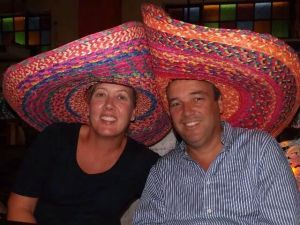
Merida – dinner out
The Spaniard Francisco de Montejo founded Merida on January 6, 1542. When the Spaniards arrived, Merida was a large Mayan city known as T’ho, situated on what is now the Main Plaza.
It was conquered by the Spaniards, who dismantled all the pyramids and used the huge stones as the foundation for the Cathedral of San Idelfonso (1556-1599), the oldest Cathedral on the American continent.
The Cathedral, situated on the east side of the Plaza, is only one of Merida’s many interesting sites. Directly across the Plaza is the Palacio Municipal (1735), Merida’s Town Hall. On the South side is the Casa de Montejo (1542), the former home of the Conqueror of Yucatan.
The Palacio de Gobierno (1892), on the North side, houses 27 murals by Fernanco Castro Pacheco, illustrating the somewhat violent history of Yucatan.
One of the major influences on Yucatan history is the henequen plant, also called sisal (for the Yucatecan city of Sisal from which shipments left the Continent). This plant became known as ‘green gold’ or ‘oro verde’ for the wealth it lavished upon the hacienda owners in this area.
In the early 20th Century, as a result of the henequen or sisal trade, Merida was the home for numerous millionaires who built their lavish homes on Paseo Montejo, and their impressive haciendas throughout the jungle surrounding Merida.
Whilst others opted to participate in additional activities and day trips, Don and I declined any of the extra day trips. We spent our days soaking up the local ambienance by wandering the streets and relaxing by the hotel pool.
As you can see, we didn’t even take any photo’s!
Day 14 & 15: Chichen Itza & Playa del Carmen
Chichen Itza is probably the most famous ancient site in Mexico. It is undoubtedly the best restored and due to it’s yucatan location receives over 1.2 million visitors a year. Many are sun seeking day trippers from Cancun and other resorts along the Mayan Riviera.
Our group pays a visit on the way from Merida to the coast. Chimi has organised a guide for us – after our Teotihuacan experience, the group opts for the ‘short version’.
You can’t help but be impressed, though Chichen Itza is more crowded and much more tourist orientated than the other ruins we have visited. Our guide also turns out to be excellent. He sets a good pace, is knowledgeable and entertaining throughout the tour.
Of course this is a UNESCO world heritage site and to save me writing pages, if you wish to read more click here.
After spending a few hours at Chichen Itza and you need a few hours, we stop for lunch and a swim in a natural cenote.
A cenote is a sink-hole, I say natural because Chimi informs us that many cenotes around the coast are not natural and have been created with the help of dynamite to enhance a tourist spot.
The water is clear and crisp, it’s a welcome relief after a morning in the humid jungle.
Our final destination is Playa del Carmen, located on the beautiful Mexican Caribbean Coast some 40 miles (60 kms) south of Cancun.
The Mayan used it as launching point for pilgrimages to Cozumel, which they held to be the home of Ixchel, the Goddess of the Moon, Love, Pregnancy and Childbirth. Though remnants of buildings left behind by this ancient civilization still dot Playa del Carmen’s shores.
Playa, as it is now affectionately known, was originally named Xaman-Ha “Waters of the North”. It’s a living vibrant part of the Maya World (Mundo Maya). A perfect base from which to explore the Cancun-Tulum Corridor of Quintana Roo (called the Mayan Riviera).
The guide books will tell you about miles of unspoiled white sandy beaches and crystal-clear Caribbean waters, a popular place for visitors looking for sun, sea and cheap margaritas.
What they fail to tell you is that you are back in ‘resort-land’. This part of Mexico caters for over 2 million of it’s northern neighbours and Europeans escaping winter.
We have one last group dinner and the following day people start to depart. A few of us are spending an extra day or two in Playa, relaxing on the beach, enjoying massages for US$20.
It is certainly the ideal spot to end a tour.
This slideshow requires JavaScript.
In Summary
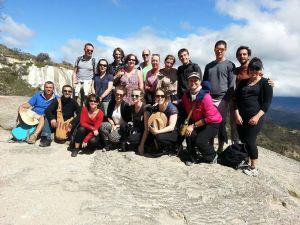
The Intrepid Travelers
We enjoyed travelling with a group much more than we thought we would. No doubt we were lucky to have had such a great bunch of people, with whom we shared many laughs througout our trip.
There is something innate in human nature, that allows a group of random individuals from different nationalities and backgrounds to travel together.
How quickly we can all adopt cultural and personal difference to create a cohesive group – at least for 15 days!
We will no doubt keep in touch with many of them, be it simply through facebook (what did we do before fb?), or better still, to catch-up again, somewhere in the world.
To our fellow intrepid travelers, I purposely did not introduce any individual through this blog. Simply because you all know the rule: “what goes on tour, stays on tour”.
Special Acknowledgements:
Intrepid Tours, Mexico Unplugged: we would recommend the trip without hesitation. We’ve been impressed with Intrepid and already booked another trip with them.
Chimi – a great tour leader, who provided his insider experience and travel expertise to make it a memorable and enjoyable trip. We also enjoyed debating and solving the problems of the world with him.
And Carlos; genuinely interested in everyone, he will no doubt make another great tour leader.
Many descriptions and information quoted are taken from Chimi’s tour notes. Thanks Chimi, hope you don’t mind.
A few photo’s are also courtesy of our Intrepid travellers, I have taken the liberty to download from fb.
23.634501
-102.552784


 automatically look for the bin to put the toilet paper in.





 Lucyandon's Adventures