Cuba is a country that has always been shrouded in mystique.
A somewhat forbidden destination, even more so if you are an American.
It conjures romantic images of rhythmic latin music and salsa dancing, the sweet smell of cigars, drinking Mojitos with Hemingway and driving 1950’s cars.
It’s a country frozen in time, slowly unthawing as it’s forced to liberalise economic and political structures to survive.
To even attempt to understand Cuba, you need to delve into it’s history. So here it goes…
The arrival of Christopher Columbus in 1492 is probably the place to start.
From this point on, the Spanish raped and pillaged the island of natural resources and decimated the native population through disease and enslavement.
Colonial Cuba provided the Spanish with timber for ships, tobacco and sugar.
Between 1756 and 1763 the ‘Seven Years War’ was fought. Simply, the French, Spanish and British were fighting over who owned what. It involved many parts of the world, including North and Central America.
As a result of the war, Britain did a deal with the Spanish; the Brits got Florida and Spain kept Cuba. Perhaps one of the most decisive points in history for Cuba.
Over time the Cubans grew resentful of the Spanish and the first War of Independence began in 1868, lasting ten years.
Whilst defeated and exiled, the revolutionaries continued to build resistance against the Spanish.
Three key rebels; Maceo, Marti and Gomez returned to Cuba in 1895, to launch the second War of Independence.
With the rebels keeping the Spanish busy, the USA took the opportunity to attack Havana resulting in the Spanish-American War.
The Spanish lost and relinquished sovereignty over Cuba to the United States in 1898. At this time, the US Navy established it’s base in Guantanamo Bay.
America returned sovereignty to the Cuban Government in 1901 and for 60 years Cuba was ruled by an unpopular military dictatorship.
In the early 1950’s the resistance movement once again gained momentum, now under the leadership of Fidel Castro and Ernesto ‘Che’ Guevera.
In 1959 Castro gained control and began to convert Cuba into a communistic system.
Castro re-ordered Cuban society, instituting land reform, building health and eduction systems and imprisoning his opponents.
Relations with the United States rapidly deteriorated; at the same time Soviet ties grew stronger.
The US imposed an embargo on Cuba in 1960 and broke diplomatic relations in 1961 (after the Bay of Pigs invasion).
Tensions peaked during the Cold War in the Cuban Missile Crisis. Cuba’s alliance with the Soviets provided protection against military attack from the US.
The Cuban economy relied strongly on Soviet support, resulting in devastating hardship with the collapse of the Soviet Union in 1989
A ‘special period’ was declared. Ration books were introduced as the country teetered on the brink of famine.
The loss of cheap petroleum from Russia was significant. Gas became unobtainable for most and contributed to the economic meltdown.
Industry, mechanised farming and food distribution all but ceased.
Many Cuban’s lost up to 25% of their body weight. They survived on drinking sugared water and eating anything they could get their hands on; you don’t see many cats in Cuba!
Cuba turned to Tourism in the 1990’s as a means to provide a much needed source of economic stimulus.
In 2006 Castro transferred power to his brother, Raul, who has continued gradual reforms, creating a somewhat capitalist-Socialist hybrid.
Before I end the history lesson, something I found interesting:
During the ‘Special Period’, research** shows that Cuba experienced an abrupt downward trend in illness, including the onset of type 2 diabetes. The research suggests this was a result of diet and exercise.
Without the availability of petrol and petroleum based chemicals, farmers returned to manual and organic farming methods. Cubans virtually became vegans overnight, as meat and dairy products vanished.
Out of adversity does come some good. Perhaps the western world with rising rates of obesity, diabetes and heart disease could learn a lesson, or two.
Day 1: Arrive Havana
Clearing immigration in Cuba takes nearly as long as the flight did.
There are 18 lanes open, each 50 people deep. It’s a haphazard queuing system and you just stand behind someone and hope for the best.
Our first impressions yield a lack of efficiency (or technology); the process is slow and very laborious.
Finding our luggage is the next challenge; there is one long conveyor belt loaded with luggage from three planes. To make room, bags are randomly scattered around the belt, which is where we found ours, hidden amongst a dozen other pieces.
Our first glimpse of how things are changing in Cuba is the long line through customs. Cubans returning are overloaded with baggage; they are carrying flat-screen televisions, ceiling fans and bundles and bundles of things.
Either there is no baggage limit, or they just paid a fortune in excess fees.
We managed to bypass the Customs queue and make a quick exit into more mayhem.
There is a sea of people waiting for passengers. Lucky for us, the Exodus staff (operating our Intrepid tour) are at the front. We are introduced to Yuri, our tour guide.
There are four of us being collected at the same time; Steve, is already on the coach and Kate turns up not long after us. They have both flown in from London.
We are surprised to find ourselves at a fairly modern looking hotel. We had set our expectations low, so this was a pleasant surprise.
All the hotels in Cuba are government owned. Many have been built in the early ’90’s, when Cuba opened itself up to tourism.
Yuri asks us to be in the lobby to depart at 8:18am, he likes to be precise – In case his name didn’t give it away, Yuri has a bit of Russian in him!
Day 2: Cienfeugos
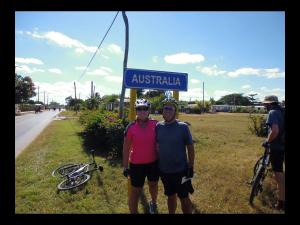
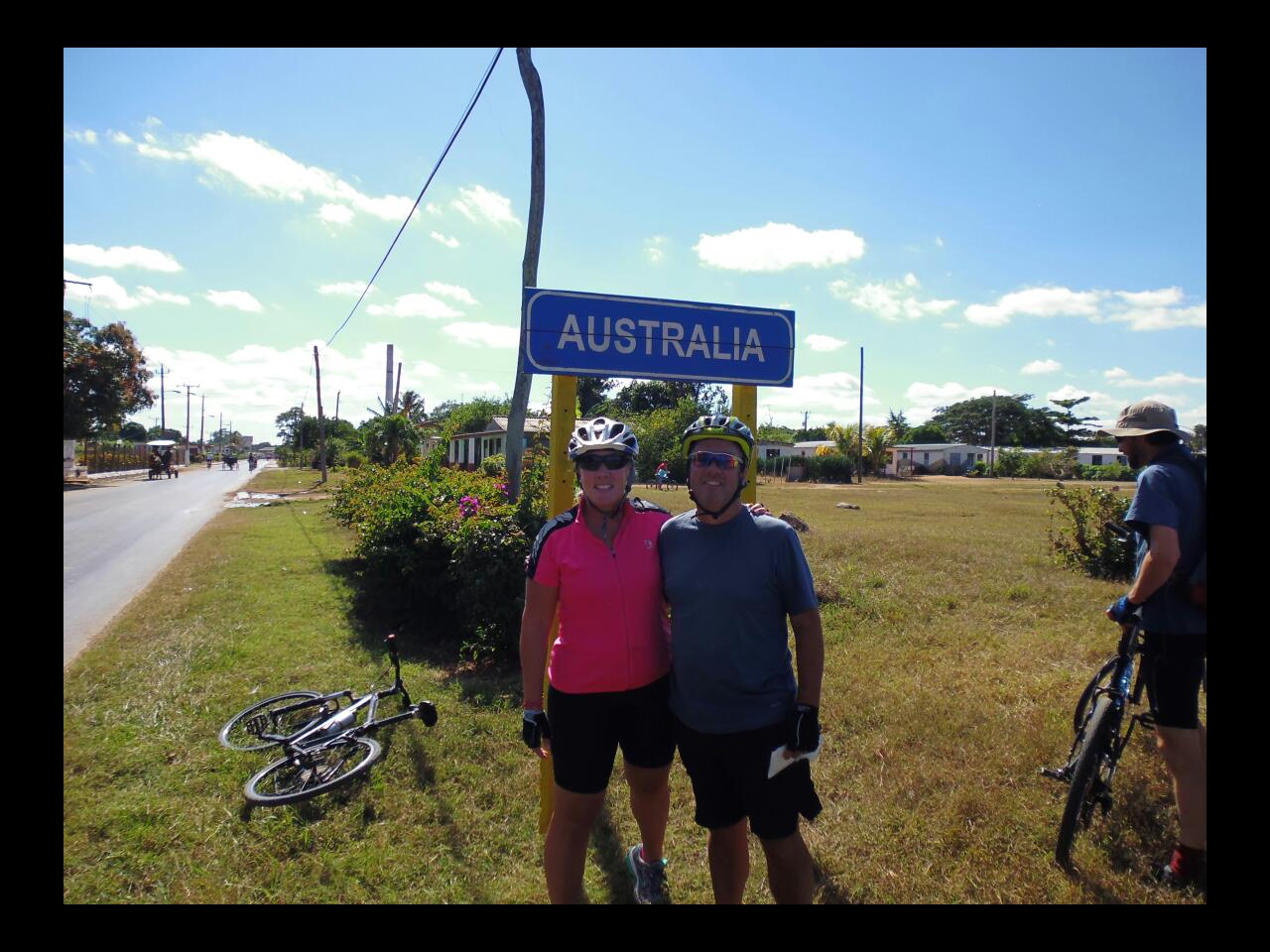
The Cycling begins in Australia!
We feel like seasoned Intrepid travelers now, but we are still full of anticipation to meet our fellow travelers.
Having met Steve and Kate the night before, we introduce ourselves to the remaining 13 as we board our coach in the morning.
The majority are from the UK: Nicola is from Edinburgh, Carla and James are from Bristol, Sarah and Andy from Manchester, Tracey and Sharon, Oxford (though Sharon is Australian).
There are also two Norwegians: Kirsti and Sidsel. Then the Antipoedians, including; Rachel from New Zealand, Marcel and Anna from Sydney and Lachie is from Brisbane.
We are missing Shelley (a Canadian living in the UK), who joins us a day later.
The coach heads east out of Havana. We will get to explore the city when we return from our cycling expedition.
Our first day of cycling starts from the township called Australia, who would have thought!
We ride to the coast and stop for Lunch. Yuri has provided cheese and ham croissants, bananas and a brownie. It hits the spot, though is not a typical Cuban meal.
Today’s ride is 40km. Having not been on bikes for months, along with hot and humid weather, it takes its toll on Don and I. We both eventually give in and take advantage of the support vehicle.
Jose, our bus driver, always remains close behind, ready to rescue a tired rider.
The riders finish at a beach and we cool off in the warm Caribbean waters, perfect to relax aching and tired muscles.
The water is so clear you can see the fish swimming up to you. Some even like having a nibble!
Back on the bus, we stop off at the museum that commemorates the Bay of Pigs invasion, a significant event in Cuba’s recent history.
We arrive at Cienfeugos around 7pm, in time to shower and change for dinner.
Everything you read about Cuba says “don’t expect anything from the food.” But, so far we have been pleasantly surprised.
Breakfast each morning has been a standard buffet affair of fresh fruits, cereals (limited to maybe the equivalent of chocolate, or plain rice bubbles) and omelets made to order. Even the coffee has been OK.
Tonight we eat at the Palacio de Valle. The beautiful building is reminiscent of Spanish-Moorish art. The restaurant specialises in seafood.
Maybe its because we just spent two months in Mexico, we’re glad to see there isn’t any derivative of a tortilla in sight.
Since seafood is the house specialty, I couldn’t go past the lobster. The first of many I have in Cuba.
Day 3: Cienfuegos to Guajimico
The colonial centre of Cienfuegos has a European flavour, wide Parisian-style boulevards and elegant colonnades, the perfect back drop to the vintage cars parked in front.
Unfortunately, we only had a short time to explore the town before we are back on our bikes. Today it’s a 45km ride.
We set off cycling outside of Cienfuegos and into the countryside, enjoying the stunning views of the Escambray Mountains across valleys of sugar cane.
The road undulates close to the coastline and through gentle hills until it reaches Guajimico.
Guajimico is a small agricultural community situated halfway between Cienfuegos and Trinidad.
We stop for lunch at a Paladar, a private restaurant (as opposed to a government one).
Since 2011, when Raul relaxed the restaurant regulations, Paladares began popping up everywhere.
Motivated to earn ‘tourist’ dollars, which in Cuba’s case means convertible pesos.
Cuba is the only country in the world to print two currencies. The local Cuban currency is CUP (coop) and in 1994 the convertible peso – CUC (kook) was introduced for tourists.
The CUP trades at 24:1 CUC. The CUC is pegged to the US dollar at 1:1.
An average Cuban earns the equivalent of $30CUC a month (just to be clear, that = US$30 a month).
The opportunities to earn CUC are on the increase and many Cuban’s are taking advantage of this.
The potential influx of American tourists and their generous tipping philosophy is just one reason Cuban’s are excited about the improving relations.
So, back to lunch: it consists of beef (I think, though beef is not very common), with rice and beans. Not what I’d choose for lunch but after 30+km of riding, we need a few carbs.
Desert is a guava syrup dripped over a soft cheese, apparently a Cuban delicacy – it didn’t taste bad at all.
We are back on our bikes for under an hour before we arrive at the seaside resort; Villa Islazul. The afternoon is free to relax, swim and enjoy the views whilst sipping a Mojito or two.
Dinner is a choice from the three Cuban staples: fish, chicken or pork. If you ask “How is it cooked”, don’t expect “grilled, baked” or even a description of some exotic sauce, the answer will simply be “good.”
Day 4 & 5: Trinidad
The ride today is along a road that clings to the shimmering Caribbean coastline all the way to Trinidad. Well, that’s the description in the tourist brochure.
What it fails to tell you is that thick dense shrubbery blocks your view of the shimmering coast and that you’ll be fighting a strong headwind all the way.
So the not so easy 20km, was also somewhat less scenic than we hoped. Though it does takes us across a few bridges providing views of picture-perfect bays.
We ride through small communities and stop on the side of the road at a stall selling fresh fruit and revive our energy with fresh coconut juice, mango, guanabana’s and other exotic fruits.
After we’ve reached Trinidad, Yuri takes us to Palacio Brunet a stunning colonial mansion dating back to the 1740’s. The building now houses the Museo Romantico.
It is packed with 18th century antiques and gives a fascinating glimpse into the lives of wealthy slave-owners during the town’s mid-colonial 18th century period.
After lunch, Yuri takes those who are interested to visit a cigar shop. Don and I decide to explore a bit on our own.
We have two nights in Trinidad in a homestay, or Casa Particulares. Since 1997, the Cuban government has allowed Cubans to rent out rooms to tourists, providing Cuban families with new sources of income and access to sought-after CUC’s.
We meet our host Josephina who warmly welcomes us into her home and shows us to a large and bright bedroom, with it’s own bathroom.
Trinidad is well preserved (and has earned a UNESCO badge); it’s like stepping back into Spanish colonial times.
The town rose to prominence during the sugar boom (early 1800’s) and the wealth generated by the industry remains visible in the town’s once grand mansions, colourful public buildings, wrought iron grill-work and cobble-stoned streets.
Trinidad is alive with music, even if it’s simply for the benefit of the tourist. Walk around a corner and a band spontaneously begins to play (or did they recognise a tourist on the way).
Many cuban’s cannot afford cars, so bicycles and horses are a regular form of transport. We meet one elderly entrepreneur who provides his donkey for photo’s. You can’t ride him, but you can have a photo with him.
Trinidad is the first town where we get a real insight into Cuban life. Walking along the cobbled streets, there are shops selling random things like beer, buckets, a freshly butchered pig.
People sell food from their homes; a horse drawn cart, or a barrow being pushed around the street sells fruit and veggies. There are no supermarkets as we know them. You may find a small store with a limited range of products lining a few shelves.
Cubans still receive rations for rice, cooking oil, eggs, chicken and pork. Children under the age of 7 receive additional milk and beef rations.
The following day is free and most of us choose to head to Playa Ancon and enjoy the beach. The keener cyclists amongst us ride the 15km.
No, that does not include Don or I, we share two vintage taxis: a well preserved 1950’s Chevy and Dodge.
Dinner that night is another seafood extravaganza; once again I dine on lobster. We are entertained with live cuban music (which wouldn’t be complete without the old classic ‘Guantanamera’).
After dinner, we head out in search of more Cuban music. We stop in the square where people are salsa dancing, then end up at Casa de la Trova which has a reputation for attracting the best Trovadors (traditional singer/songwriters).
Day 6: Topes de Collantes National Park/Lake Hanabanilla
We leave Trinidad on the coach and wind up over the stunning Topes de Collantes National Park and coffee plantations.
Cuba was once rich in coffee production, producing 60,000 tonnes annually, it’s production now is around 6,000 tonnes.
One reason is the lack of interest in farming. Why would you want to be a farmer in Cuba; working long laborious days, 7 days a week, earning the same $30CUC as someone else working in a comfortable office?
We stop for coffee in the National Park and a few of the more serious cyclists sign waivers and head off to add a few more up-hill kilometres to the daily ride.
The majority of us are more sensible and start the ride in the valley. The scenery is lush with small farms and villages giving way to open vistas as we descend towards Manicaragua.
Lunch is sandwiches and then we start the final climb towards Hanabanilla, situated on the shores of Lake Hanabanilla and surrounded by lush tropical hills.
This is one of the most beautiful days in terms of scenery, it just happens to be a long, gruelling uphill slog.
There were many moments where I was tempted to throw it in and wave down the bus, I can hear it chugging slowly along behind us, but with the encouragement of my cycling companions, who appealed to my competitive nature, I pushed through, (by-the-way, Don retired long before).
Exhausted and elated as I wobbled off the bike in front of our hotel, a barman greets me with a well earned Cuba Libra. Now, that’s the way to finish a bike ride.
A nearby Paladar served lovely fresh trout. The food is again ample and comes to US$13 a head. It was one of the best meals of the trip.
Day 7: Santa Clara to Havana
In the morning we take the bus to Santa Clara. This was the first major city to be liberated by Castro’s army in December 1958.
Today a number of monuments commemorate this important period of Cuba’s history, including the mausoleum of the legendary Che Guevara, where we stop for a visit.
Guevara remains both a revered and reviled historical figure, polarized in the collective imagination in a multitude of biographies, memoirs, essays, documentaries, songs, and films.
As a result of his perceived martyrdom, poetic invocations for class struggle, and desire to create the consciousness of a “new man” driven by moral, rather than material incentives, he has evolved into a quintessential icon of various leftist-inspired movements.***
I love that Cuban museums hoard everything from baby photo’s, school reports and even a tube of the guy’s toothpaste!
If you are interested in knowing more about Che, read his book; ‘The Motorcycle Diaries: Notes on Latin American Journey’
At this point we say goodbye to Sarah and Andy, who are heading off to spend a few days in the sun.
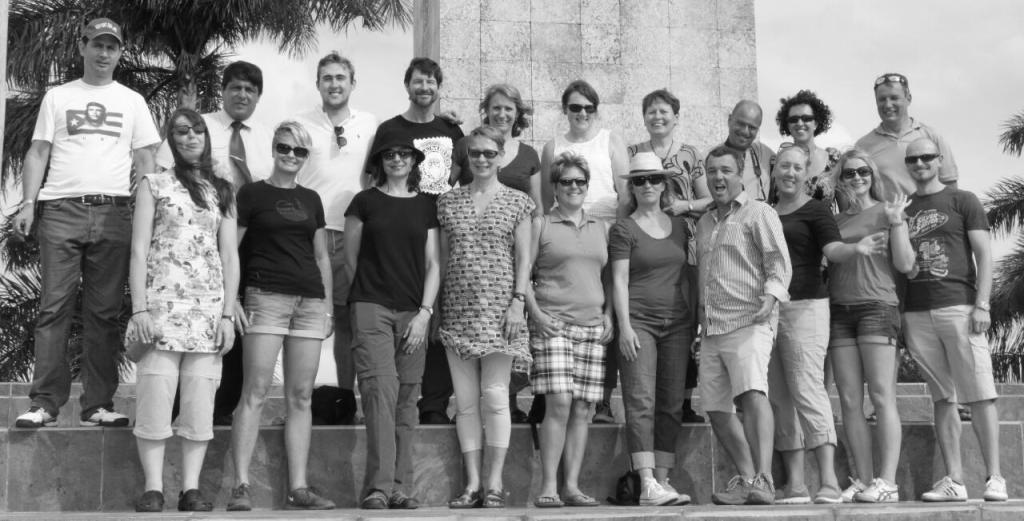
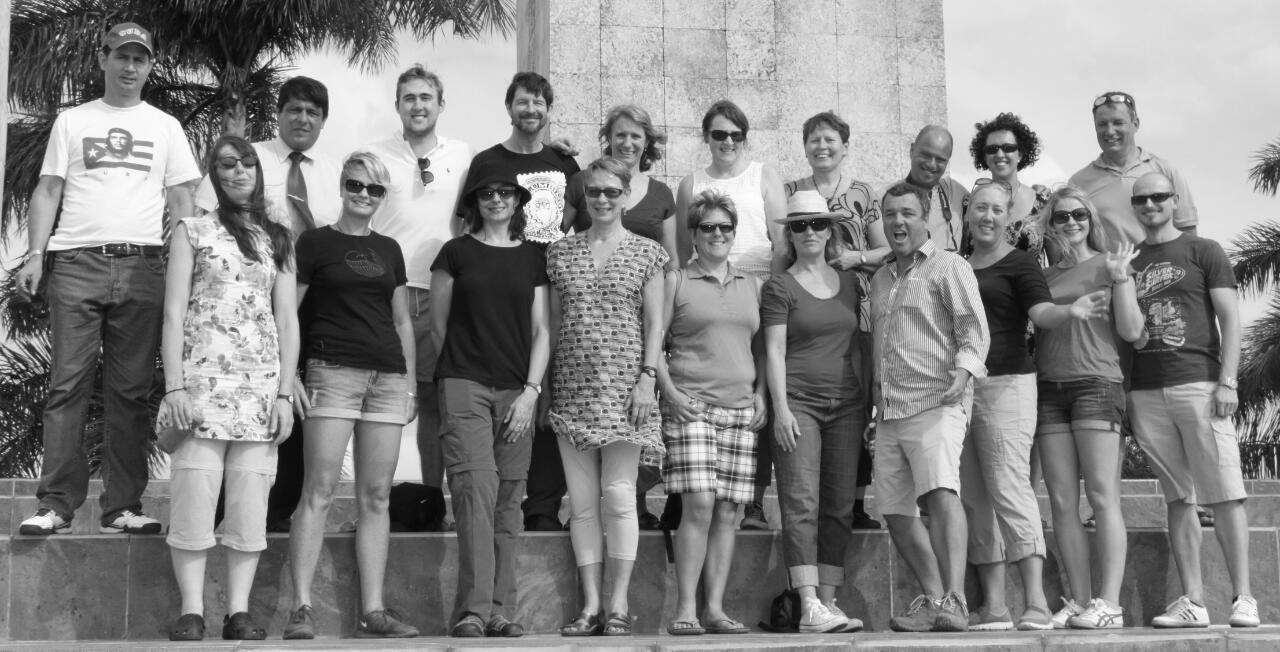
The cycling gang
Day 8: Havana
Our final day with our Intrepid companions is spent walking through Havana with Yuri as our guide.
We are back in Havana, claimed to be one of the finest colonial cities in the Americas with narrow streets, spacious plazas and glorious Spanish architecture.
However, there is an air of faded grandeur about the place with paint peeling off buildings and ’50s and ’60s American automobiles still dominating the roads.
There are significant restoration works underway and like Bordeaux (France), you can see that Havana will soon be returned to it’s former glory.
It’s Christmas day, though, there are very few signs of this; there are no christmas trees or decorations and no festivites going on.
Religion was banned under Castro’s regime; churches were shut down, or occupied by the government.
Religious groups survived in secrecy until the Pope’s visit in 1998. Castro relaxed his attitude and even made Christmas day a public holiday. Religious celebrations still remain conservative.
Old cars dominate the street scape. US car imports came to a halt in 1959 when America placed embargos and Castro stopped Cubans purchasing cars on credit.
Few cars were imported after this, except for a few from Europe and Russia, which provided Laudas and heavy vehicles.
In Havana, you do begin to feel like you have a target on your back. Everyone is trying to make a dollar out of you.
It’s almost impossible to take a photo without someone expecting a tip. There are women brightly dressed in traditional Cuban costumes, plus a street parade that really isn’t a street parade, but rather more performers wanting a tip.
You do get a bit cynical by the end.
With Obama’s efforts to improve relations with Cuba the doors are open and the future opportunities for Cuba are looking promising.
The biggest question will be whether it can survive its struggle to hold onto its socialist ideology?
This slideshow requires JavaScript.
References
* City of Cienfuegas web site
** http://www.theatlantic.com/health/archive/2013/04/how-cubans-health-improved-when-their-economy-collapsed/275080/
***Copied text from http://en.m.wikipedia.org/wiki/Che_Guevara
Interesting read: http://www.foreignaffairs.com/articles/139458/julia-e-sweig-and-michael-j-bustamante/cuba-after-communism
23.159167
-82.271056


 Botswana Ngoma




 Lucyandon's Adventures