
Machu Picchu & Cuzco
4 -5 May, Cuzco
Tucked away on a beautiful peninsula overlooking Lake Umayo are the ruins of Sillustani, our first stop after leaving Puno.
Built by a pre-Inca civilisation hundreds of years ago, the Sillustani Indians built several “Chullpas”; funeral towers whose construction is far more complex than anything the Inca people ever built.
Each tower would have contained the remains of noble men, buried together with offerings to secure their comfortable passage into the next life.
After exploring the ruins it’s back to the truck for a 440km drive to Cuzco.


On arrival into Cuzco we have a quick shower before heading out to the Fallen Angel restaurant for a group dinner.
This results in a rather late night (though I think we were the first to depart for bed), the effects of alcohol mixed with altitude (we are at 3,450m) take their toll on most of the gang, including us!
The Cuzco region is the heart and soul of Peru. The city itself is the continent’s oldest continuously inhabited city and was the home of the Incas for two centuries before the Spanish built their first capital here.
Steeped in history, tradition and legend, Cuzco is a fascinating mix of both cultures. Inca-built walls line the central streets and many of the elegant colonial buildings are built on or around Inca foundations.
There are five of us not doing a Machu Picchu hike and we will have plenty of time to explore the town, with its cobblestone streets that lead to many Baroque churches and ancient temples.
6 May, Sacred Valley
The Sacsayhuman ruins are located just outside the city. These ruins are best known for the gigantic blocks that make up the zigzag frontal of this fort-like construction.
The ancient monolithic stonework is unique. There is much speculation as to how the stonemasons of the time could fit the irregular shapes together, without the use of mortar. It’s the perfect jigsaw.
The largest blocks could weight over 120 metric tons and stand over 8 metres in height.
There are many theories as to why Sacsayhuaman was originally built and what it was used for, but the most likely is that it was a temple complex where offerings were made to appease the gods.


We then head into the Sacred Valley with a quick stop at an animal sanctuary, before we reach the mountainside ruins of ancient Pisac.
Most notable are the curving agricultural terraces stretching down the hillside providing a sweeping vista of the valley below.
The religious buildings in particular are as finely made as those at Machu Picchu, and the site features one of Peru’s only remaining intihuatanas, enigmatic carved rocks that were used for astronomical observation.


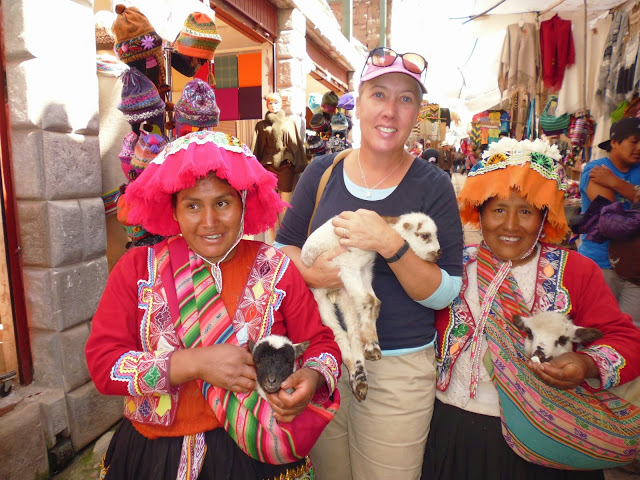
Pisac Markets
The current town of Pisac is now located beneath the ruins and hosts a popular artisanal market, so we venture down for a bit of shopping.
Our Lunch is at Alhambra Hacienda in the small town of Urubamba.
I’m not normally a fan of a buffet, but this one is exceptional, with much of the ingredients grown on the property.
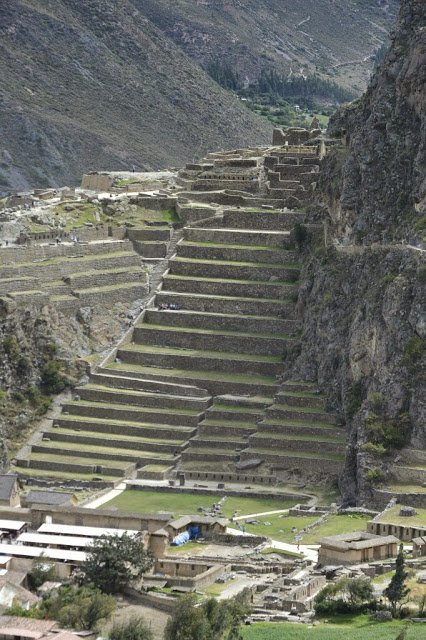
Ollantaytambo Ruins
In 1536, the settlement of Ollantaytambo was the site of the Inca’s greatest military victory over the invading Spaniards.
Today, it is one of the only towns in Peru that retains its original Inca walls and street grid, dominated by long, ancient stone walls that once divided groups of homes around communal courtyards.
An imposing set of stone terraces (from which the Inca assaulted their Spanish invaders with slingshots and arrows), capped by six enigmatic slabs of pink granite, looms above the town.
Our final stop for the day is in the village of Chinchero at a women’s community textile project. The women are dressed in traditional clothing and speaking native Quechua.
We are welcomed with tea and shown how they spin, thread, weave and dye the wool with natural dyes, using ancient techniques.
The quality of work is the best we’ve seen in this part of the world; the fine baby alpaca products were beautiful.
Alas, our pockets were nearly empty and whilst I could have purchased much more, Don acquired a jumper. I’ll just have to find an excuse to go back one day!


7-8 May, Cuzco
Left to our own devices for the next two days, we spend our time relaxing and exploring more of Cuzco.
Our daily adventures begin with breakfast at Jacks Cafe Cusco, the best coffee we have had in South America. Not surprisingly, it’s run by an Australian.
The city offers free (tip based) walking tours each day. There are a number of guides touting for business and we end up with our own private guide for two hours exploring the city.
Our best adventure would be in search of wine. Reasonable quality wine is hard to find, especially outside the mass produced supermarket brands such as Fronterra and Casillero del Diablo, which we are all too familiar with.
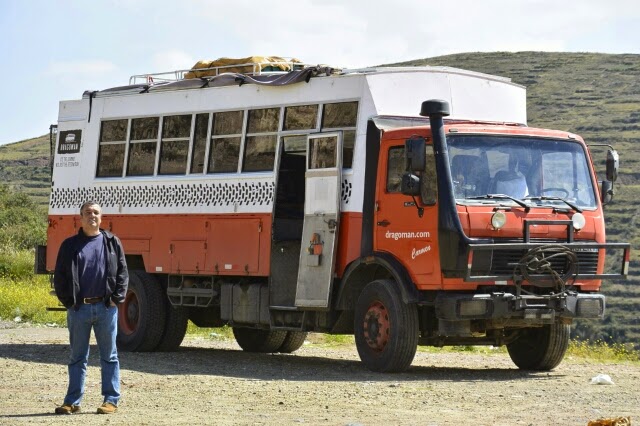
On the way into town, the truck had passed a wine shop. Back tracking the route was not so easy. Carmen had had a little difficulty navigating through Cuzco to our hotel.
Starting at the Mercado San Pedro, the usual spectacle of freshly butchered meats and fresh produce, we can’t go past a freshly squeezed juice – a mix of strawberry, bananas, kiwifruit and who know what for 6 sol (AUS$2.70). My cup was topped up three times from the blender.
Our efforts paid off. We found the one and only liquor store in Cuzco which had a good range of wine at reasonable prices. We also haggled for a ‘special-price’ for a dozen.
With our box of wine in hand, we hailed a taxi, who asked for 5 sol (AUS$2.30). This is probably overpaying, but reasonable to us. As seems to often be the case, we also went via the petrol station and filled-up, with the engine still running!
When we got out, I noted the car had no taxi markings whatsoever. We’d jumped into a random car, with the driver out to make 5 sol!
9 May, Ollantaytambo
Today we head back to Ollantaytambo to meet our hiking companions. We will spend the night in the town, leaving only a 2 hour train journey the following day to Machu Picchu.
Don and I take a hike up to the Pinkulluna ruins, the climb is steep, but the view back over the town is worth it.


10 May, Machu Picchu
An early train to Aguas Calientes allows us to get to Machu Picchu before the trains from Cusco arrive and be ahead of the crowd.
The train trip provides for some spectacular scenery as it winds deep into the Andes. The vegetation grows thick and wild as we follow the Urubamba River and the towering mountain peaks disappear into the clouds.
Machu Picchu has been a long anticipated highlight and it does not disappoint. It is one of those genuinely magical places, and catching your first glimpse of the lost city is definitely a moment you never forget.
The ruins of this forgotten city are stunningly located, perched high on a rocky escarpment, surrounded by verdant cloud forest, with the river running through the gorge far below.
Hidden away, Machu Picchu is invisible from below, so it’s no surprise its ruins remained a secret for so many years.
Discovered in 1911 by the explorer Hiram Bingham, although the ruins were heavily covered by dense jungle foliage, many of the buildings were well preserved and in excellent condition.
Historians believe the city was probably completely self-contained, surrounded by agricultural terraces sufficient to feed all it’s inhabitants and watered by natural springs.
It’s thought that the city was the location of a royal palace and estate, home to the Inca Emperors, or possibly a sacred religious and ceremonial sight.
The city consists of more than 200 buildings, from houses to temples, storage buildings and public spaces. It’s fascinating to be able to gaze down on the city from above and imagine how it would have looked during the height of the Inca empire.
Note: I contained myself with the number of photos (more available upon request)!
12 May, Cuzco
Back in Cuzco for the last day we tick off some more historic sites and museums (after breakfast at Jack’s, of course).
The Church of Santo Domingo is built on the site of one of the most important temples of the Inca Empire. Qurikancha, the temple of the Sun God, would have been the most prominent temple and astronomical observatory in Cuzco.
The carved granite walls were once covered in gold, its courtyard filled with golden life-size sculptures of animals, even the temple floor was covered in solid gold. All, until pillaged by the Spanish conquistadors.
The Spanish demolished most of the temple to build the current Church on its foundations, using the Inca stonework in its construction.
A credit to Inca stone masonry and architectural design with its unique interlocking design, has been its ability to withstand the test of time and several severe earthquakes.
Our tickets also included the Convent of Santa Catalina, so why not…
In Inca times the most beautiful and virtuous noblewomen where selected to live in Acllawasi and devoted their lives to the Sun God. They weaved clothes for ceremonial purposes and assisted in religious ceremonies.
Upon the Spanish occupation of Cuzco, a convent was founded on the same site in 1601.
The Museo Machu Picchu is a must-see. It is dedicated to preserving the history of Machu Picchu and houses over 4,000 artifacts, including some 366 objects that have been returned by Yale University in recent times (they really should return everything). I’m tempted to say more, but will bite my tongue.
As far as museums go, this one has done a pretty good job at telling its story.
A video starts you of with the history of and there are little videos aligned with displays throughout.
Enough culture for one day, we meet up with some of the gang to enjoy happy hour cocktails at Fallen Angel.
Don & I limit our cocktail intake (not wanting a repeat of night 1). We’ve decided to treat ourselves with dinner at Le Soleil, a French restaurant with a great reputation. And it was a superb meal.
13 May, Departing Cuzco
We are heading out at 8:00am. Lucky for us, Jack’s opens at 7:30, so we have time to get down there and grab our last coffee before we go.
We pass Tige and Lewis on the way, who also put in take-out orders.
I have to make a quick visit to the Cathedral, which I have so far failed to do – only because I refuse to pay to go into a church (refer to Sienna). If you arrive before 9:00am its free.
The Spanish made a habit of building on top of Inca places of significance, this site had previously been the Inca Viracocha’s palace.
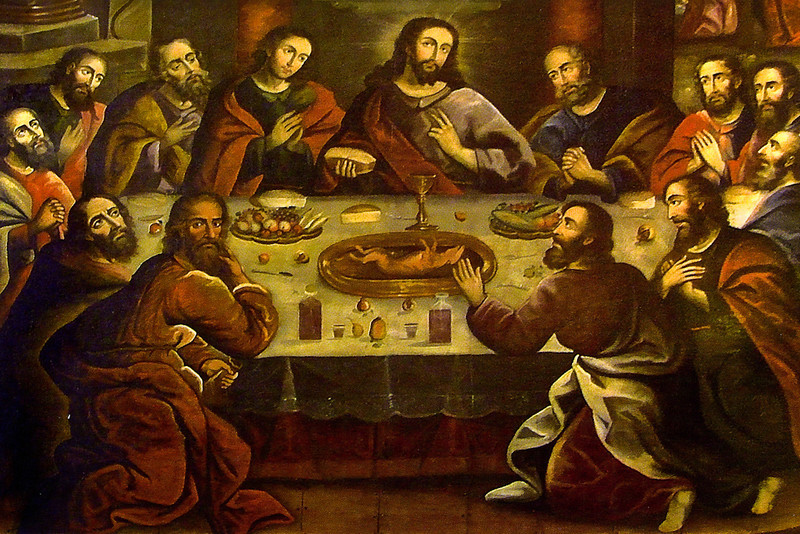
Whilst its renowned for its colonial art, my main purpose is to view the painting of the Last Supper.
It’s not much different than any other depiction, except for what the Apostles are feasting on: Andean fruits and…..is that a guinea pig?



 Lucyandon's Adventures